
Concept Test
- This question paper has five sections, A to E. All sections are compulsory.
- Section A has six questions of 1 mark each (four multiple choice and two assertion–reason). Section B has three questions of 2 marks each. Section C has three questions of 3 marks each. Section D has one case-based question of 4 marks. Section E has one question of 5 marks; it has an internal choice.
- There is no overall choice. Where an internal choice is given, attempt either the question or its alternative (OR).
- Use of calculators is not allowed. Write the answers in the order of the questions, giving the question number before each answer.
Consider the following chemical equation :
p Al + q H2O → r Al2O3 + s H2
To balance this chemical equation, the values of ‘p’, ‘q’, ‘r’ and ‘s’ must be respectively :
A chemical reaction in which exchange of ions occurs between the reactants, is known as :
Identify the product 'X' obtained in the following chemical reaction :
CaCO3 →(Δ) 'X' + CO2
Zn + 2CH3COOH → (CH3COO)2Zn + H2. The above reaction is a:
Assertion (A) : Reaction of quick lime with water is an exothermic reaction.
Reason (R) : A large amount of heat is evolved on the reaction of quick lime and water.
Assertion (A): Silver chloride turns grey in sunlight.
Reason (R): Decomposition of silver chloride into silver and chlorine takes place by sunlight.
What is meant by a balanced chemical equation ? Why is it necessary for the equation to be balanced ?
Giving one example of each, differentiate between a displacement reaction and a double displacement reaction.
Give one example of each of the following :
(i) Chemical reaction showing evolution of gas.
(ii) Change in the colour of the substance during a chemical reaction.
Define the following terms :
(a) Corrosion
(b) Rancidity
(c) Endothermic reaction [3×1]
Translate the following statements into chemical equation and then balance them :
(a) Water is added to quicklime
(b) Burning of natural gas
(c) Thermal decomposition of ferrous sulphate
Write one chemical equation each for the chemical reaction in which the following have taken place :
(i) Change in colour
(ii) Change in temperature
(iii) Formation of precipitate
Mention colour change/temperature change (rise/fall)/compound precipitated along with equation.
In Activity 1.7, a student passed electric current through water containing a few drops of dilute sulphuric acid, using carbon electrodes. Gas bubbles formed at both electrodes and collected in inverted test tubes; one tube collected twice as much gas as the other.
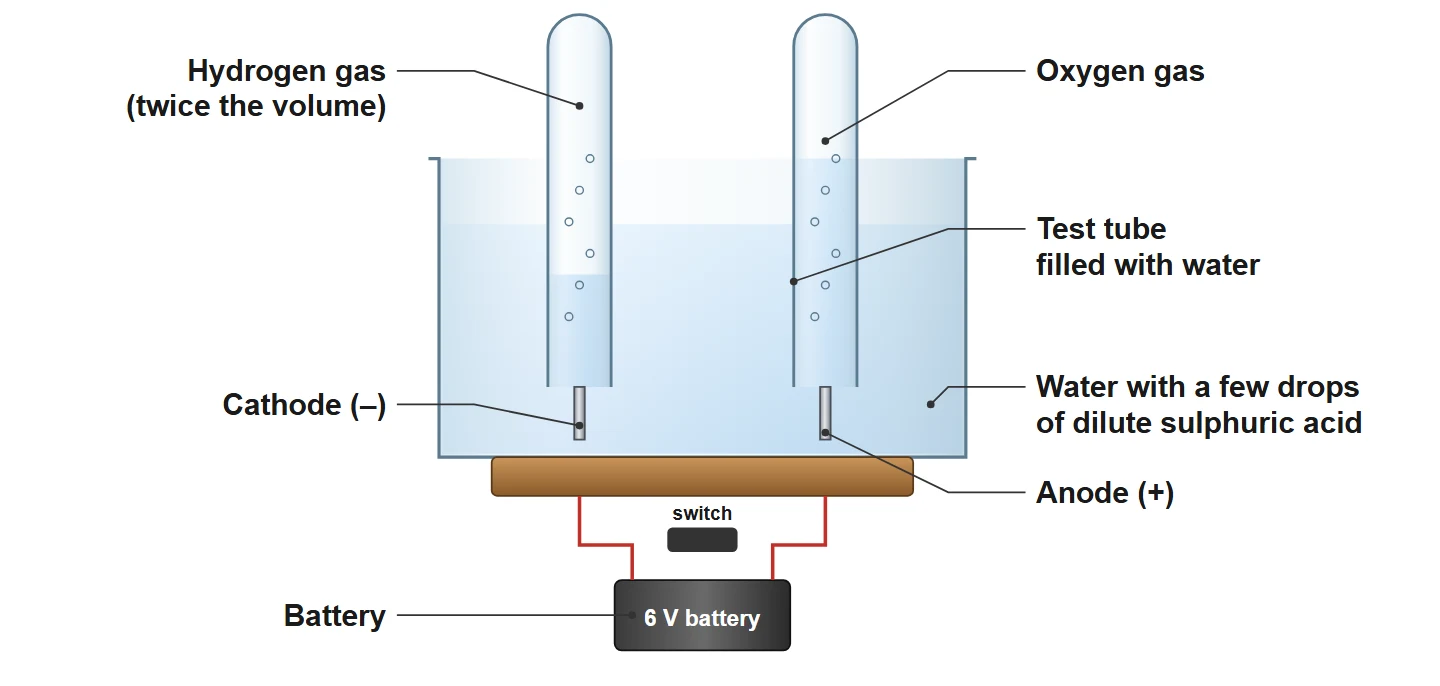
Name the gas collected in larger volume.
Why are a few drops of dilute sulphuric acid added?
(i) Write the balanced equation and name the type of reaction. OR (ii) How can the two gases be tested?
What is a chemical reaction? Describe one activity each to show that a chemical change has occurred in which (i) change of colour, and (ii) change in temperature has taken place.
What happens when a piece of (a) zinc metal is added to copper sulphate solution? (b) aluminium metal is added to dilute hydrochloric acid? (c) silver metal is added to copper sulphate solution? Also, write the balanced chemical equation if the reaction occurs
Please keep this page open (up to a minute)