
Application of Derivatives: Class 12 PYQs 2016–2026 with solutions
All 45 CBSE board questions asked from Application of Derivatives in 15 board papers, with the year, set and marks of each. 25 are solved free below. The Class 12 Maths PYQ Book: Solved Board Papers 2016-2026 (CBSE) has every solution, all chapters and 19 full board papers.
Subject experts: Ruchi Agarwal (B.Tech, M.Tech) and Vinay Wadhwani (B.Tech Electrical Engineering)



Free: NCERT solutions for Class 12 Maths →
Application of Derivatives: board weightage
Board weightage 2016–2026
| Year | 2016 | 2017 | 2018 | 2019 | 2020 | 2022 | 2023 | 2024 | 2025 | 2026 |
|---|---|---|---|---|---|---|---|---|---|---|
| Questions | 2 | 3 | 3 | 2 | 5 | – | 6 | 7 | 9 | 8 |
| Marks | 12 | 10 | 10 | 12 | 15 | – | 17 | 16 | 23 | 22 |
Most asked topics
45 questions from 15 papers. Repeated questions are shown once with every year they were asked.
Jump to: 1 mark2 marks3 marks4 marks5 marks6 marks
1 mark: MCQ and Assertion–Reason
The least value of , is
Solution
Answer: (A) –16
(in [0, 3]).
, , . Least value .
For
Solution
Answer: (C)
; .
At : , local maximum . At : , local minimum .
The absolute maximum value of function in [0, 2] is :
Solution
Answer: (C) 4
. , , . Maximum .
The function is increasing in the interval
Solution
Answer: (D)
.
A cylindrical tank of radius 10 cm is being filled with sugar at the rate of 100π cm³/s. The rate, at which the height of the sugar inside the tank is increasing, is :
Solution
Answer: (C) 1 cm/s
, cm/s.
Let f(x) be a continuous function on [a, b] and differentiable on (a, b). Then, this function f(x) is strictly increasing in (a, b) if
Solution
Answer: (B)
The function is :
If is strictly decreasing in R, then 'a' belongs to
The radius of a circle is increasing at the uniform rate of 3 cm/sec. At the instant when the radius of the circle is 2 cm, its area increases at the rate of ________ cm²/s.
The interval in which the function f given by is strictly increasing, is
If the radius of the circle is increasing at the rate of 0.5 cm/s, then the rate of increase of its circumference is ________.
2 marks: very short answer
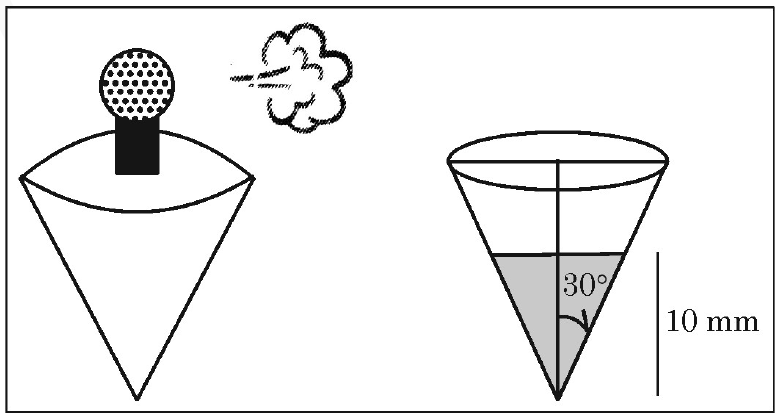
A room freshner bottle in the shape of an inverted cone sprays the perfume at regular intervals such that volume of the perfume in the bottle decreases at the steady rate of 1 mm³/min. Find the rate at which level of perfume is dropping at an instant when level of perfume in the bottle is 10 mm, if the semi-vertical angle of conical bottle is .
Solution
Let the level be h and the radius of the surface r. Semi-vertical angle : .
(volume decreases)
At h = 10:
The level is dropping at mm/min.
Find the absolute maximum value of ,
Solution
or .
; ; .
Absolute maximum value (at )
If the volume of a solid hemisphere increases at a uniform rate, prove that its surface area varies inversely as its radius.
Solution
, (constant) .
Total surface area of a solid hemisphere .
So the rate of change of surface area varies inversely as the radius. Hence proved.
Find the intervals in which function is (i) increasing (ii) decreasing.
Solution
Domain .
.
(i) For , : f is increasing on [0, 1].
(ii) For , : f is decreasing on [1, ∞).
Find the values of 'a' for which is increasing on R.
Solution
for all x for all x. Since the least value of is –1, .
Show that the function has neither maxima nor minima.
Solution
for all x.
only at , and does not change sign there (positive on both sides). So f is increasing on R and is a point of inflexion: f has neither maxima nor minima.
If M and m denote the local maximum and local minimum values of the function respectively, find the value of (M – m).
Solution
; .
: , local maximum . : , local minimum .
–4
Show that is strictly increasing in its domain.
Show that the function , is strictly decreasing in .
A particle moves along the curve such that at a point with x-coordinate 1, y-coordinate is changing twice as fast at x-coordinate. Find the value of a.
The total cost C(x) associated with the production of x units of an item is given by . Find the marginal cost when 3 units are produced, where by marginal cost we mean the instantaneous rate of change of total cost at any level of output.
The volume of a cube is increasing at the rate of 9 cm³/s. How fast is its surface area increasing when the length of an edge is 10 cm ?
Show that the function is increasing on R.
3 marks: short answer
The side of an equilateral triangle is increasing at the rate of 3 cm/s. At what rate its area increasing when the side of the triangle is 15 cm ?
Solution
Area , cm/s.
At : cm²/s
4 marks: case-based / source-based
An online delivery company in a city has 5000 subscribers and collects annual subscription fees of ₹ 300 per subscriber for unlimited free deliveries. The company wishes to increase the annual subscription fee. It is predicted that, for every increase of ₹ 1, ten subscribers will discontinue. Assume that the company increased the annual fee by ₹ x.
(i) How many subscribers will discontinue after an increase of ₹ x in annual fee ? (1)
(ii) If R(x) denotes the total revenue collected after the increase of ₹ x in subscription fee, express R(x) as a function of x. (1)
(iii) (a) Find the value of x for which R(x) is maximum. (2)
OR
(iii) (b) Find the sub-intervals of (0, 5000) in which R(x) is increasing and decreasing. (2)
Solution
(i) Ten subscribers leave for every ₹ 1, so 10x subscribers discontinue.
(ii) Subscribers , fee :
(iii) (a) ; .
, so R is maximum at x = 100 (fee ₹ 400).
OR (iii) (b) for and for .
R(x) is increasing in (0, 100) and decreasing in (100, 5000).
A technical company is designing a rectangular solar panel installation on a roof using 300 metres of boundary material. The design includes a partition running parallel to one of the sides dividing the area (roof) into two sections. Let the length of the side perpendicular to the partition be x metres and with parallel to the partition be y metres.
(i) Write the equation for the total boundary material used in the boundary and parallel to the partition in terms of x and y. (1)
(ii) Write the area of the solar panel as a function of x. (1)
(iii) (a) Find the critical points of the area function. Use second derivative test to determine critical points at the maximum area. Also, find the maximum area. (2)
OR
(iii) (b) Using first derivative test, calculate the maximum area the company can enclose with the 300 metres of boundary material, considering the parallel partition. (2)
Solution
(i) Two sides of length x, two sides of length y and the partition of length y:
(ii) :
(iii) (a) (critical point). : maximum at .
Maximum area 3750 m² (y = 50 m)
OR (iii) (b) is positive for and negative for , so A changes from increasing to decreasing at : maximum. Maximum area 3750 m².
A small town is analyzing the pattern of a new street light installation. The lights are set up in such a way that the intensity of light at any point x metres from the start of the street can be modelled by , where x is in metres.
(i) Find the intervals on which the f(x) is increasing or decreasing, x ∈ [0, π]. (2)
(ii) Verify, whether each critical point when x ∈ [0, π] is a point of local maximum or local minimum or a point of inflexion. (2)
Solution
(i) . in .
For , : increasing on ; for , : decreasing on .
(ii) The only critical point is . .
, so is a point of local maximum (f′ changes sign from + to –); it is not a point of inflexion.
The traffic police has installed Over Speed Violation Detection (OSVD) system at various locations in a city. These cameras can capture a speeding vehicle from a distance of 300 m and even function in the dark. A camera is installed on a pole at the height of 5 m. It detects a car travelling away from the pole at the speed of 20 m/s. At any point, x m away from the base of the pole, the angle of elevation of the speed camera from the car C is θ.
(i) Express θ in terms of height of the camera installed on the pole and x. (1)
(ii) Find . (1)
(iii) (a) Find the rate of change of angle of elevation with respect to time at an instant when the car is 50 m away from the pole. (2)
OR
(iii) (b) If the rate of change of angle of elevation with respect to time of another car at a distance of 50 m from the base of the pole is rad/s, then find the speed of the car. (2)
Solution
(i)
(ii)
(iii) (a) . At x = 50: rad/s (the angle decreases at rad/s).
OR (iii) (b) . Speed = 15 m/s.
Overspeeding increases fuel consumption and decreases fuel economy as a result of tyre rolling friction and air resistance. While vehicles reach optimal fuel economy at different speeds, fuel mileage usually decreases rapidly at speeds above 80 km/h.
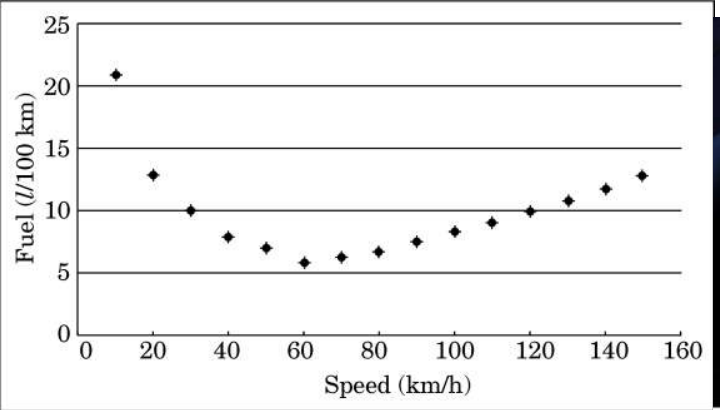
The relation between fuel consumption F (l/100 km) and speed V (km/h) under some constraints is given as .
(i) Find F, when V = 40 km/h. (1)
(ii) Find . (1)
(iii) (a) Find the speed V for which fuel consumption F is minimum. (2)
OR
(iii) (b) Find the quantity of fuel required to travel 600 km at the speed V at which . (2)
Solution
(i) 7.2 l/100 km
(ii)
(iii) (a) ; : minimum at V = 62.5 km/h.
OR (iii) (b) km/h.
l per 100 km. For 600 km: 37.2 litres
A tank, as shown in the figure below, formed using a combination of a cylinder and a cone, offers better drainage as compared to a flat bottomed tank. A tap is connected to such a tank whose conical part is full of water. Water is dripping out from a tap at the bottom at the uniform rate of 2 cm³/s. The semi-vertical angle of the conical tank is 45°.
(i) Find the volume of water in the tank in terms of its radius r. (1)
(ii) Find rate of change of radius at an instant when cm. (1)
(iii) (a) Find the rate at which the wet surface of the conical tank is decreasing at an instant when radius cm. (2)
OR
(iii) (b) Find the rate of change of height 'h' at an instant when slant height is 4 cm. (2)
Engine displacement is the measure of the cylinder volume swept by all the pistons of a piston engine. The piston moves inside the cylinder bore. The cylinder bore in the form of circular cylinder open at the top is to be made from a metal sheet of area 75π cm².
(i) If the radius of cylinder is r cm and height is h cm, then write the volume V of cylinder in terms of radius r. (1)
(ii) Find . (1)
(iii) (a) Find the radius of cylinder when its volume is maximum. (2)
OR
(iii) (b) For maximum volume, h > r. State true or false and justify. (2)
The use of electric vehicles will curb air pollution in the long run. The use of electric vehicles is increasing every year and estimated electric vehicles in use at any time t is given by the function V : , where t represents the time and t = 1, 2, 3, … corresponds to year 2001, 2002, 2003, … respectively.
(i) Can the above function be used to estimate number of vehicles in the year 2000 ? Justify. (2)
(ii) Prove that the function V(t) is an increasing function. (2)
Find the intervals in which the function is (a) strictly increasing, (b) strictly decreasing.
An open tank with a square base and vertical sides is to be constructed from a metal sheet so as to hold a given quantity of water. Show that the cost of material will be least when depth of the tank is half of its width. If the cost is to be borne by nearby settled lower income families, for whom water will be provided, what kind of value is hidden in this question ?
5 marks: long answer
Find the sub intervals in which , is increasing and decreasing.
Solution
The denominator is always positive, so the sign of is that of .
.
In : , — decreasing.
In : , — increasing.
A rectangle of perimeter 36 cm is revolved around one of its sides to sweep out a cylinder of maximum volume. Find the dimensions of the rectangle.
Solution
Let the sides be x and y: . Revolving about side y gives a cylinder of radius x and height y.
()
at : maximum.
Dimensions: 12 cm × 6 cm (revolved about the 6 cm side; maximum volume cm³).
Find the absolute maximum and absolute minimum of function on [1, 5].
6 marks: long answer
Show that the height of the right circular cylinder of greatest volume which can be inscribed in a right circular cone of height h and radius r is one-third of the height of the cone, and the greatest volume of the cylinder is times the volume of the cone.
Solution
Let the cylinder have radius x and height H. By similar triangles, .
;
at : maximum.
(one-third of the cone's height).
, i.e. of the cone's volume. Hence shown.
Amongst all open (from the top) right circular cylindrical boxes of volume 125π cm³, find the dimensions of the box which has the least surface area.
Solution
.
; : minimum.
Radius 5 cm, height 5 cm
A tank with rectangular base and rectangular sides, open at the top is to be constructed so that its depth is 2 m and volume is 8 m³. If building of tank costs ₹ 70 per square metre for the base and ₹ 45 per square metre for the sides, what is the cost of least expensive tank ?
Solution
Base x m × y m, depth 2: .
Cost
; : minimum. Then y = 2.
Least cost ₹ 1000
Show that the height of the cylinder of maximum volume that can be inscribed in a sphere of radius R is . Also find the maximum volume.
Solution
Cylinder of height h and radius r inside the sphere: .
;
: maximum. Then .
cubic units
Show that the surface area of a closed cuboid with square base and given volume is minimum, when it is a cube.
Prove that is an increasing function of θ on .
Show that semi-vertical angle of a cone of maximum volume and given slant height is .
Get every solution for all chapters
- Every board question of every chapter, each fully solved the way the board gives marks
- 19 complete board papers, each followed by its solutions
- Weightage and most-asked topics for every chapter
- Instant PDF download, colour and black & white print copies
Revising the chapter first? Complete Maths Notes for Class 12 (NCERT 2026-27, CBSE Board 2027) →
What you get in the pack
- Questions from 138 CBSE papers, 2016 to 2026: every set code available
- Complete: 2439 different questions and parts from all set codes, 13 chapters and 19 full papers
- Part A: all 13 chapters, questions sorted chapter-wise and by marks
- Year-wise weightage table and most-asked topics for every chapter
- Part B: 19 full board papers, each followed by its complete solutions
- Every integral, proof, LPP graph and probability question worked line by line
- Questions on topics out of the board syllabus flagged
All chapters in this pack
- PYQ Ch 1 Relations and Functions
- PYQ Ch 2 Inverse Trigonometric Functions
- PYQ Ch 3 Matrices
- PYQ Ch 4 Determinants
- PYQ Ch 5 Continuity and Differentiability
- PYQ Ch 6 Application of Derivatives
- PYQ Ch 7 Integrals
- PYQ Ch 8 Application of Integrals
- PYQ Ch 9 Differential Equations
- PYQ Ch 10 Vector Algebra
- PYQ Ch 11 Three Dimensional Geometry
- PYQ Ch 12 Linear Programming
- PYQ Ch 13 Probability
- Board Paper 2026 Set 65-1-1 with Solutions
- Board Paper 2026 Set 65-1-2 with Solutions
- Board Paper 2026 Set 65-1-3 with Solutions
- Board Paper 2026 Set 65-2-1 with Solutions
- Board Paper 2025 Set 65-1-1 with Solutions
- Board Paper 2025 Set 65-2-1 with Solutions
- Board Paper 2024 Set 65-1-1 with Solutions
- Board Paper 2024 Set 65-2-1 with Solutions
- Board Paper 2023 Set 65-1-1 with Solutions
- Board Paper 2023 Set 65-2-1 with Solutions
- Board Paper 2022 Term 2 Set 65-1-1 with Solutions
- Board Paper 2022 Term 2 Set 65-2-1 with Solutions
- Board Paper 2020 Set 65-1-1 with Solutions
- Board Paper 2020 Set 65-2-1 with Solutions
- Board Paper 2019 Set 65-1-1 with Solutions
- Board Paper 2019 Set 65-2-1 with Solutions
- Board Paper 2018 Set 65-1 with Solutions
- Board Paper 2017 Set 65-1 with Solutions
- Board Paper 2016 Set 65-1 with Solutions