Continuity and Differentiability: Class 12 PYQs 2016–2026 with solutions
All 65 CBSE board questions asked from Continuity and Differentiability in 15 board papers, with the year, set and marks of each. 34 are solved free below. The Class 12 Maths PYQ Book: Solved Board Papers 2016-2026 (CBSE) has every solution, all chapters and 19 full board papers.
If f(x)=∣x∣+∣x−1∣, then which of the following is correct ?
(A) f(x) is both continuous and differentiable, at x = 0 and x = 1.(B) f(x) is differentiable but not continuous, at x = 0 and x = 1.(C) f(x) is continuous but not differentiable, at x = 0 and x = 1.(D) f(x) is neither continuous nor differentiable, at x = 0 and x = 1.
Solution
Answer: (C)
A sum of modulus functions is continuous everywhere. f(x)=1−2x (x<0), 1 (0≤x≤1), 2x−1 (x>1): the slopes jump from –2 to 0 at x=0 and from 0 to 2 at x=1, so f is not differentiable there.
Q3 · CBSE 2025 · 65/1/1 · Q201 mark
Assertion (A) : f(x)={3x−8,2k,x≤5x>5 is continuous at x=5 for k=25.
Reason (R) : For a function f to be continuous at x = a, x→a−limf(x)=x→a+limf(x)=f(a).
(A) Both A and R are true and R is the correct explanation of A. (B) Both A and R are true but R is not the correct explanation of A. (C) A is true but R is false. (D) A is false but R is true.
Solution
Answer: (D)
f(5)= LHL =15−8=7; RHL =2k. Continuity needs 2k=7, i.e. k=27, not 25. A is false, R is true.
Q4 · CBSE 2025 · 65/2/1 · Q141 mark
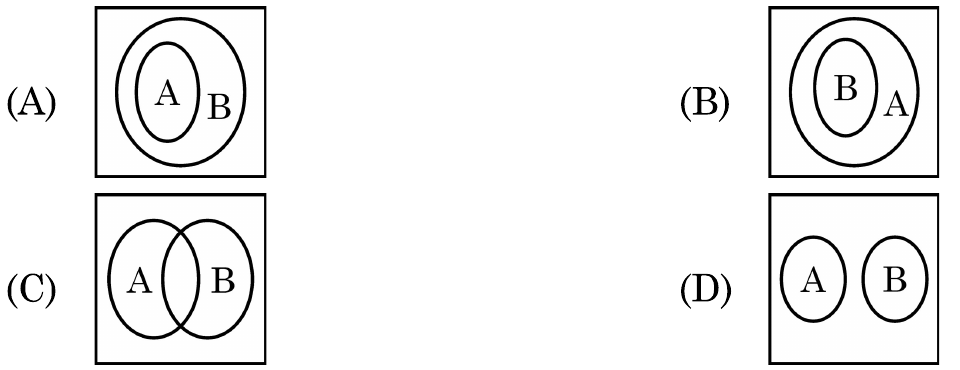
If A denotes the set of continuous functions and B denotes set of differentiable functions, then which of the following depicts the correct relation between set A and B ?
Solution
Answer: (B)
Every differentiable function is continuous, but not conversely (e.g. ∣x∣), so B⊂A: B is drawn inside A.
Q5 · CBSE 2024 · 65/1/1 · Q31 mark
Which of the following statements is true for the function f(x)={x2+3,1,x=0x=0 ?
(A) f(x) is continuous and differentiable ∀ x ∈ R(B) f(x) is continuous ∀ x ∈ R(C) f(x) is continuous and differentiable ∀ x ∈ R – {0}(D) f(x) is discontinuous at infinitely many points
Solution
Answer: (C)
limx→0f(x)=3=f(0)=1, so f is discontinuous (hence not differentiable) at 0. Elsewhere it is the polynomial x2+3, continuous and differentiable.
Q6 · CBSE 2024 · 65/1/1 · Q131 mark
The derivative of sin(x2) w.r.t. x, at x=π is :
(A) 1(B) –1(C) −2π(D) 2π
Solution
Answer: (C)
dxdsinx2=2xcosx2; at x=π: 2πcosπ=−2π.
Q7 · CBSE 2024 · 65/2/1 · Q41 mark
The number of points of discontinuity of f(x)=⎩⎨⎧∣x∣+3,−2x,6x+2,x≤−3−3<x<3x≥3 is :
(A) 0(B) 1(C) 2(D) infinite
Solution
Answer: (B) 1
At x=−3: LHL =3+3=6, RHL =6, f(−3)=6: continuous. At x=3: LHL =−6, RHL =20: discontinuous. Each piece is continuous elsewhere.
Q8 · CBSE 2024 · 65/2/1 · Q131 mark
The derivative of tan−1(x2) w.r.t. x is :
(A) 1+x4x(B) 1+x42x(C) −1+x42x(D) 1+x41
Solution
Answer: (B)
1+(x2)21⋅2x.
Q9 · CBSE 2023 · 65/1/1 · Q131 mark
The value of k for which f(x)={3x+5,kx2,x≥2x<2 is a continuous function, is :
(a) −411(b) 114(c) 11(d) 411
Solution
Answer: (d)
At x = 2: 4k=3(2)+5=11⇒k=411.
Q10 · CBSE 2023 · 65/2/1 · Q151 mark
The function f(x)=x∣x∣ is
(A) continuous and differentiable at x = 0.(B) continuous but not differentiable at x = 0.(C) differentiable but not continuous at x = 0.(D) neither differentiable nor continuous at x = 0.
Solution
Answer: (A)
LHD =limh→0−h−h∣−h∣=0, RHD =limh→0hh∣h∣=0; equal, so differentiable (hence continuous).
Q11 · CBSE 2023 · 65/2/1 · Q161 mark
If tan(x−yx+y)=k, then dxdy is equal to
(A) x−y(B) xy(C) sec2(xy)(D) −sec2(xy)
Full step-by-step solution is in the PYQ book (US$1.99).
Q12 · CBSE 2020 · 65/1/1 · Q121 mark
The greatest integer function defined by f(x) = [x], 0 < x < 2 is not differentiable at x = ________.
Full step-by-step solution is in the PYQ book (US$1.99).
Q13 · CBSE 2020 · 65/2/1 · Q41 mark
The function f : R → R given by f(x) = – |x – 1| is
(A) continuous as well as differentiable at x = 1(B) not continuous but differentiable at x = 1(C) continuous but not differentiable at x = 1(D) neither continuous nor differentiable at x = 1
Full step-by-step solution is in the PYQ book (US$1.99).
Q14 · CBSE 2020 · 65/2/1 · Q16(a)1 mark
Differentiate sec2(x2) with respect to x2.
Full step-by-step solution is in the PYQ book (US$1.99).
Q15 · CBSE 2020 · 65/2/1 · Q16(b)1 mark
If y=f(x2) and f′(x)=ex, then find dxdy.
Full step-by-step solution is in the PYQ book (US$1.99).
Q16 · CBSE 2020 · 65/2/1 · Q171 mark
Find the value of k, so that the function f(x)={kx2+5,2,x≤1x>1 is continuous at x = 1.
Full step-by-step solution is in the PYQ book (US$1.99).
Q17 · CBSE 2019 · 65/1/1 · Q21 mark
If f(x) = x + 1, find dxd(fof)(x).
Full step-by-step solution is in the PYQ book (US$1.99).
Q18 · CBSE 2019 · 65/2/1 · Q21 mark
If y=x∣x∣, find dxdy for x < 0.
Full step-by-step solution is in the PYQ book (US$1.99).
Q19 · CBSE 2017 · 65/1 · Q21 mark
Determine the value of 'k' for which the following function is continuous at x = 3 : f(x)=⎩⎨⎧x−3(x+3)2−36,k,x=3x=3
Full step-by-step solution is in the PYQ book (US$1.99).
2 marks: very short answer
Q20 · CBSE 2026 · 65/1/1 · Q21(a)2 marks
Check whether function f(x) defined as f(x)=⎩⎨⎧2(x−3)∣x−3∣,6x−6,x<3x≥3 is continuous at x=3 or not ?
Solution
For x<3, ∣x−3∣=−(x−3), so f(x)=2(x−3)−(x−3)=−21.
LHL =x→3−limf(x)=−21.
RHL =x→3+lim6x−6=63−6=−21; f(3)=63−6=−21.
LHL = RHL = f(3), so f is continuous at x = 3.
Q21 · CBSE 2026 · 65/1/1 · Q21(b)2 marks
If 3(x2+y2)=4xy, then find dxdy at (21,23).
Solution
Differentiate w.r.t. x: 3(2x+2ydxdy)=4y+4xdxdy
dxdy(23y−4x)=4y−23x⇒dxdy=3y−2x2y−3x
At (21,23): numerator =3−23=23; denominator =23−1=21.
dxdy=3
Q22 · CBSE 2026 · 65/2/1 · Q222 marks
If x=asin3t, y=bcos3t, then find dxdy at t=4π.
Solution
dtdx=3asin2tcost, dtdy=−3bcos2tsint
dxdy=3asin2tcost−3bcos2tsint=−abcott
At t=4π: dxdy=−ab
Q23 · CBSE 2025 · 65/1/1 · Q21(a)2 marks
Differentiate 2cos2x w.r.t. cos2x.
Solution
Let u=2cos2x and v=cos2x.
dxdu=2cos2xlog2⋅(−2cosxsinx); dxdv=−2cosxsinx
dvdu=dv/dxdu/dx=2cos2xlog2
(Directly: u=2v, so dvdu=2vlog2.)
Q24 · CBSE 2025 · 65/1/1 · Q21(b)2 marks
If tan−1(x2+y2)=a2, then find dxdy.
Solution
x2+y2=tana2 (a constant). Differentiate: 2x+2ydxdy=0⇒dxdy=−yx
Full step-by-step solution is in the PYQ book (US$1.99).
Q42 · CBSE 2024 · 65/2/1 · Q26(a)3 marks
If x=ecos3t and y=esin3t, prove that dxdy=−xlogyylogx.
Full step-by-step solution is in the PYQ book (US$1.99).
Q43 · CBSE 2024 · 65/2/1 · Q26(b)3 marks
Show that : dxd(∣x∣)=∣x∣x, x=0
Full step-by-step solution is in the PYQ book (US$1.99).
4 marks: case-based / source-based
Q44 · CBSE 2026 · 65/2/1 · Q384 marks
Sports car racing is a form of motorsport which uses sports car prototypes. The competition is held on special tracks designed in various shapes. The equation of one such track is given as follows : f(x)={x4−4x2+4,x2+40,0≤x<3x≥3 (i) Find f′(x) for 0<x<3. (1) (ii) Find f′(4) (1) (iii) (a) Test for continuity of f(x) at x = 3. (2) OR (iii) (b) Test for differentiability of f(x) at x = 3. (2)
OR (iii) (b) LHD =h→0lim−hf(3−h)−f(3)=h→0lim−h(3−h)4−4(3−h)2+4−49=4(27)−8(3)=84
RHD =h→0limh(3+h)2+40−49=h→0limh6h+h2=6
LHD ≠ RHD, so f is not differentiable at x = 3.
Q45 · CBSE 2023 · 65/1/1 · Q384 marks
The equation of the path traced by a roller-coaster is given by the polynomial f(x) = a(x + 9)(x + 1)(x – 3). If the roller-coaster crosses y-axis at a point (0, –1), answer the following : (i) Find the value of 'a'. (2) (ii) Find f″(x) at x = 1. (2)
Solution
(i) f(0)=a(9)(1)(−3)=−27a=−1⇒a=271
(ii) (x+9)(x+1)(x−3)=(x2+10x+9)(x−3)=x3+7x2−21x−27.