
Linear Programming: Class 12 PYQs 2016–2026 with solutions
All 33 CBSE board questions asked from Linear Programming in 15 board papers, with the year, set and marks of each. 18 are solved free below. The Class 12 Maths PYQ Book: Solved Board Papers 2016-2026 (CBSE) has every solution, all chapters and 19 full board papers.
Subject experts: Ruchi Agarwal (B.Tech, M.Tech) and Vinay Wadhwani (B.Tech Electrical Engineering)



Free: NCERT solutions for Class 12 Maths →
Linear Programming: board weightage
Board weightage 2016–2026
| Year | 2016 | 2017 | 2018 | 2019 | 2020 | 2022 | 2023 | 2024 | 2025 | 2026 |
|---|---|---|---|---|---|---|---|---|---|---|
| Questions | 1 | 2 | 1 | 2 | 4 | – | 6 | 5 | 6 | 6 |
| Marks | 6 | 6 | 6 | 12 | 10 | – | 10 | 10 | 10 | 10 |
Most asked topics
33 questions from 15 papers. Repeated questions are shown once with every year they were asked.
Jump to: 1 mark2 marks3 marks4 marks6 marks
1 mark: MCQ and Assertion–Reason
The feasible region of a linear programming problem with objective function is shown below :
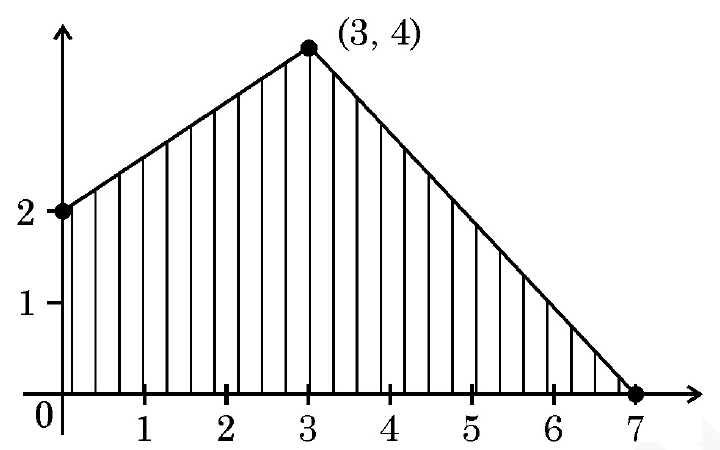
The maximum value of Z – minimum value of Z is
Solution
Answer: (D) 43
Corner points: (0, 0), (0, 2), (3, 4), (7, 0).
Z: (0, 0) → 0; (0, 2) → 14; (3, 4) → 15 + 28 = 43; (7, 0) → 35. Max = 43, min = 0, difference = 43.
The degree of an objective function of a linear programming problem is
Solution
Answer: (B) 1
The objective function is linear, so its degree is 1.
In a linear programming problem, the linear function which has to be maximized or minimized is called
Solution
Answer: (B) an objective function
For the feasible region shown below, the non-trivial constraints of the linear programming problem are
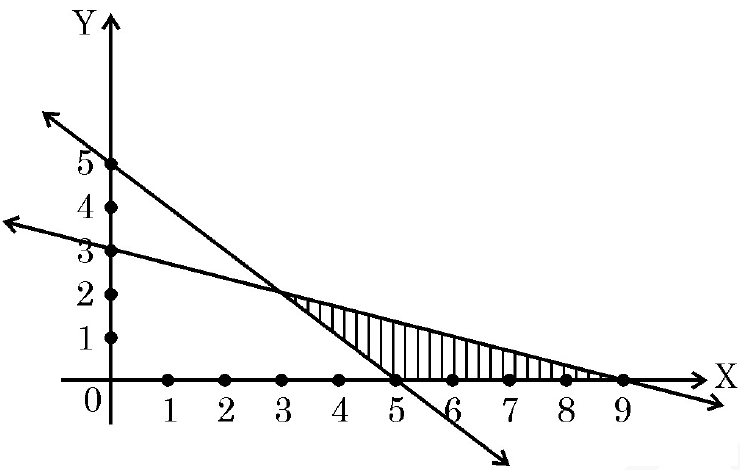
Solution
Answer: (C)
The lines are (through (5, 0), (0, 5)) and (through (9, 0), (0, 3)). The shaded region is away from the origin for the first line () and on the origin side of the second ().
The corner points of the feasible region in graphical representation of a L.P.P. are (2, 72), (15, 20) and (40, 15). If be the objective function, then
Solution
Answer: (C)
Z(2, 72) = 36 + 648 = 684; Z(15, 20) = 270 + 180 = 450; Z(40, 15) = 720 + 135 = 855. Maximum at (40, 15), minimum at (15, 20).
If the feasible region of a linear programming problem with objective function , is bounded, then which of the following is correct ?
Solution
Answer: (C)
On a bounded feasible region, Z attains both a maximum and a minimum, each at a corner point.
A factory produces two products X and Y. The profit earned by selling X and Y is represented by the objective function Z = 5x + 7y, where x and y are the number of units of X and Y respectively sold. Which of the following statement is correct ?
Solution
Answer: (C)
Z = 5x + 7y adds the profits from the two products (₹5 per unit of X, ₹7 per unit of Y).
Assertion (A) : Every point of the feasible region of a Linear Programming Problem is an optimal solution.
Reason (R) : The optimal solution for a Linear Programming Problem exists only at one or more corner point(s) of the feasible region.
Solution
Answer: (D) (as per the marking scheme)
Only the points where Z attains its optimum value are optimal solutions; not every feasible point is. R reflects the corner-point theorem: the optimum (if it exists) occurs at a corner point.
A linear programming problem deals with the optimization of a/an :
Solution
Answer: (B) linear function
The number of corner points of the feasible region determined by constraints , , is :
The common region determined by all the constraints of a linear programming problem is called :
The corner points of the feasible region in the graphical representation of a linear programming problem are (2, 72), (15, 20) and (40, 15). If z = 18x + 9y be the objective function, then :
The number of corner points of the feasible region determined by the constraints , , , is :
The objective function Z = ax + by of an LPP has maximum value 42 at (4, 6) and minimum value 19 at (3, 2). Which of the following is true ?
The corner points of the feasible region of a linear programming problem are (0, 4), (8, 0) and . If Z = 30x + 24y is the objective function, then (maximum value of Z – minimum value of Z) is equal to
The corner points of the feasible region determined by the system of linear inequalities are (0, 0), (4, 0), (2, 4) and (0, 5). If the maximum value of z = ax + by, where a, b > 0 occurs at both (2, 4) and (4, 0), then
The corner points of the feasible region of an LPP are (0, 0), (0, 8), (2, 7), (5, 4) and (6, 0). The maximum profit P = 3x + 2y occurs at the point ________.
2 marks: very short answer
Two tailors, A and B, earn ₹ 300 and ₹ 400 per day respectively. A can stitch 6 shirts and 4 pairs of trousers while B can stitch 10 shirts and 4 pairs of trousers per day. To find how many days should each of them work and if it is desired to produce at least 60 shirts and 32 pairs of trousers at a minimum labour cost, formulate this as an LPP.
Solution
Let A work x days and B work y days.
Minimise subject to (i.e. ), (i.e. ), , .
3 marks: short answer
Solve the following linear programming problem graphically : Minimize subject to constraints , , ,
Solution
Draw (through (7, 0), (0, 7)) and (through (0, 2), (–3, 0)). The origin satisfies both inequalities, so the feasible region is on the origin side of both lines, in the first quadrant (shaded).
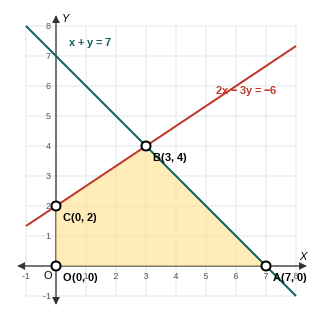
Corner points: O(0, 0), A(7, 0), B(3, 4) [solving and ], C(0, 2).
| Corner point | Z = 13x – 15y |
|---|---|
| O(0, 0) | 0 |
| A(7, 0) | 91 |
| B(3, 4) | 39 – 60 = –21 |
| C(0, 2) | –30 |
The region is bounded, so the minimum value is Z = –30 at x = 0, y = 2.
Solve the following linear programming problem graphically : Maximize subject to constraints , ,
Solution
Lines: through (50, 0), (0, 50); through (40, 0), (0, 80). Both inequalities hold at the origin, so the feasible region is OABC (shaded).
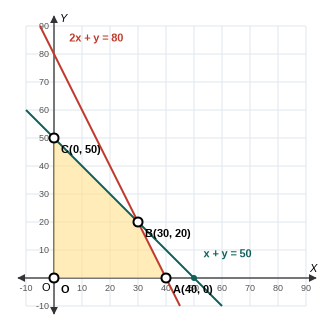
Corner B: subtract from : , .
| Corner point | Z = 10500x + 9000y |
|---|---|
| O(0, 0) | 0 |
| A(40, 0) | 4,20,000 |
| B(30, 20) | 3,15,000 + 1,80,000 = 4,95,000 |
| C(0, 50) | 4,50,000 |
Maximum Z = 4,95,000 at x = 30, y = 20.
Solve the following linear programming problem graphically : Maximise subject to the constraints : , , ,
Solution
: region on or below . : region on or below (contains O). The lines meet at A(2, 2). The feasible region (shaded) is unbounded.
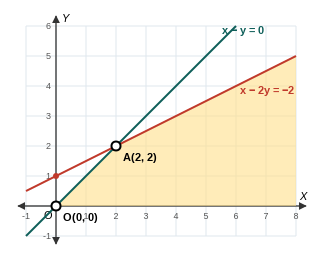
| Corner point | Z = x + 2y |
|---|---|
| O(0, 0) | 0 |
| A(2, 2) | 6 |
Since the region is unbounded, check : this half-plane has points in common with the feasible region (e.g. (10, 0) gives Z = 10). So Z has no maximum value.
Solve the following linear programming problem graphically : Minimise subject to the constraints : , , , ,
Solution
The region lies below , above , right of and below (shaded, bounded).
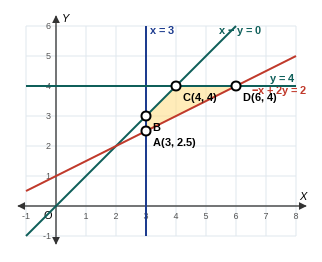
Corners: A(3, 2.5) [, ], B(3, 3) [, ], C(4, 4) [, ], D(6, 4) [, ].
| Corner point | Z = x – 5y |
|---|---|
| A(3, 2.5) | –9.5 |
| B(3, 3) | –12 |
| C(4, 4) | –16 |
| D(6, 4) | –14 |
Minimum Z = –16 at x = 4, y = 4.
Solve the following linear programming problem graphically : Maximise , subject to constraints , , , ,
Solve graphically the following linear programming problem : Maximise z = 6x + 3y, subject to the constraints , , , , .
Solve the following linear programming problem graphically : Minimize : Z = 5x + 10y subject to constraints : , , , ,
4 marks: case-based / source-based
The month of September is celebrated as the Rashtriya Poshan Maah across the country. Following a healthy and well-balanced diet is crucial in order to supply the body with the proper nutrients it needs. A balanced diet also keeps us mentally fit and promotes improved level of energy. A dietician wishes to minimize the cost of a diet involving two types of foods, food X (x kg) and food Y (y kg) which are available at the rate of ₹ 16/kg and ₹ 20/kg respectively. The feasible region satisfying the constraints is shown in Figure-2.
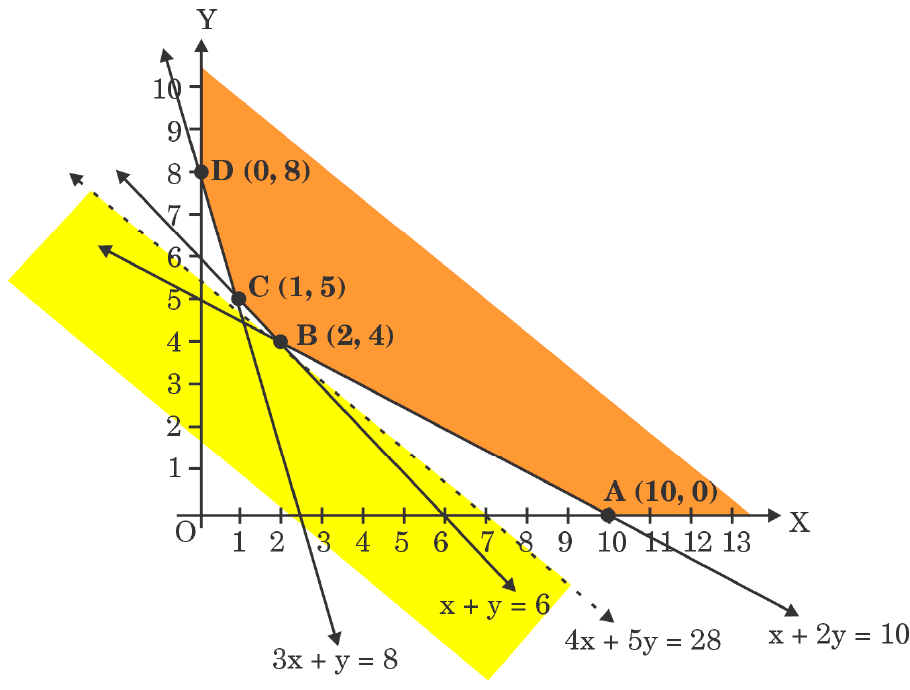
(i) Identify and write all the constraints which determine the given feasible region in Figure-2. (2)
(ii) If the objective is to minimize cost Z = 16x + 20y, find the values of x and y at which cost is minimum. Also, find minimum cost assuming that minimum cost is possible for the given unbounded region. (2)
Solution
(i) The region lies on the side away from the origin of , and , in the first quadrant (corners A(10, 0), B(2, 4), C(1, 5), D(0, 8)):
, , , ,
(ii)
| Corner point | Z = 16x + 20y |
|---|---|
| A(10, 0) | 160 |
| B(2, 4) | 112 |
| C(1, 5) | 116 |
| D(0, 8) | 160 |
Minimum cost ₹ 112 at x = 2 kg, y = 4 kg. (The half-plane 16x + 20y < 112, i.e. 4x + 5y < 28, has no point in common with the region, which confirms the minimum.)
A furniture trader deals in only two items — chairs and tables. He has ₹ 50,000 to invest and a space to store at most 35 items. A chair costs him ₹ 1,000 and a table costs him ₹ 2,000. The trader earns a profit of ₹ 150 and ₹ 250 on a chair and table, respectively. Formulate the above problem as an LPP to maximise the profit and solve it graphically.
Solution
Let x chairs and y tables. Maximise subject to (i.e. ), , .
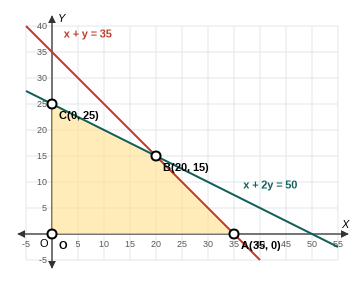
Corner B: , , .
| Corner point | Z = 150x + 250y |
|---|---|
| O(0, 0) | 0 |
| A(35, 0) | 5250 |
| B(20, 15) | 3000 + 3750 = 6750 |
| C(0, 25) | 6250 |
Maximum profit ₹ 6750 with 20 chairs and 15 tables.
A cottage industry manufactures pedestal lamps and wooden shades. Both the products require machine time as well as craftsman time in the making. The number of hour(s) required for producing 1 unit of each and the corresponding profit is given in the following table :
| Item | Machine Time | Craftsman time | Profit (₹) |
|---|---|---|---|
| Pedestal lamp | 1.5 hours | 3 hours | 30 |
| Wooden shades | 3 hours | 1 hour | 20 |
In a day, the factory has availability of not more than 42 hours of machine time and 24 hours of craftsman time. Assuming that all items manufactured are sold, how should the manufacturer schedule his daily production in order to maximise the profit ? Formulate it as an LPP and solve it graphically.
Maximize Z = x + 2y subject to the constraints , , , . Solve the above LPP graphically.
6 marks: long answer
A manufacturer has employed 5 skilled men and 10 semi-skilled men and makes two models A and B of an article. The making of one item of model A requires 2 hours work by a skilled man and 2 hours work by a semi-skilled man. One item of model B requires 1 hour by a skilled man and 3 hours by a semi-skilled man. No man is expected to work more than 8 hours per day. The manufacturer's profit on an item of model A is ₹ 15 and on an item of model B is ₹ 10. How many of items of each model should be made per day in order to maximize daily profit ? Formulate the above LPP and solve it graphically and find the maximum profit.
Solution
Let x items of A, y of B. Skilled hours available , semi-skilled .
Maximise subject to , , .
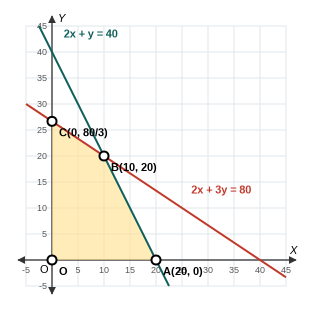
Corner B: , , .
| Corner point | Z = 15x + 10y |
|---|---|
| O(0, 0) | 0 |
| A(20, 0) | 300 |
| B(10, 20) | 350 |
| C(0, 80/3) | 266.67 |
Make 10 items of A and 20 of B; maximum profit ₹ 350.
A company produces two types of goods, A and B, that require gold and silver. Each unit of type A requires 3 g of silver and 1 g of gold while that of type B requires 1 g of silver and 2 g of gold. The company can use at the most 9 g of silver and 8 g of gold. If each unit of type A brings a profit of ₹ 40 and that of type B ₹ 50, find the number of units of each type that the company should produce to maximize profit. Formulate the above LPP and solve it graphically and also find the maximum profit.
Solution
Let x units of A, y of B. Maximise subject to , , .
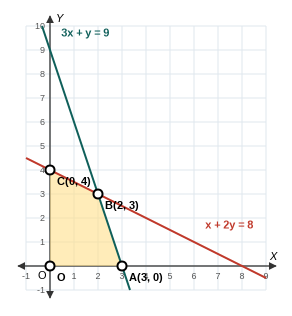
Corner B: , , .
| Corner point | Z = 40x + 50y |
|---|---|
| O(0, 0) | 0 |
| A(3, 0) | 120 |
| B(2, 3) | 230 |
| C(0, 4) | 200 |
Produce 2 units of A and 3 units of B; maximum profit ₹ 230.
A factory manufactures two types of screws A and B, each type requiring the use of two machines, an automatic and a hand-operated. It takes 4 minutes on the automatic and 6 minutes on the hand-operated machines to manufacture a packet of screws 'A' while it takes 6 minutes on the automatic and 3 minutes on the hand-operated machine to manufacture a packet of screws 'B'. Each machine is available for at most 4 hours on any day. The manufacturer can sell a packet of screws 'A' at a profit of 70 paise and screws 'B' at a profit of ₹ 1. Assuming that he can sell all the screws he manufactures, how many packets of each type should the factory owner produce in a day in order to maximize his profit ? Formulate the above LPP and solve it graphically and find the maximum profit.
A retired person wants to invest an amount of ₹ 50,000. His broker recommends investing in two type of bonds 'A' and 'B' yielding 10% and 9% return respectively on the invested amount. He decides to invest at least ₹ 20,000 in bond 'A' and at least ₹ 10,000 in bond 'B'. He also wants to invest at least as much in bond 'A' as in bond 'B'. Solve this linear programming problem graphically to maximise his returns.
Get every solution for all chapters
- Every board question of every chapter, each fully solved the way the board gives marks
- 19 complete board papers, each followed by its solutions
- Weightage and most-asked topics for every chapter
- Instant PDF download, colour and black & white print copies
Revising the chapter first? Complete Maths Notes for Class 12 (NCERT 2026-27, CBSE Board 2027) →
What you get in the pack
- Questions from 138 CBSE papers, 2016 to 2026: every set code available
- Complete: 2439 different questions and parts from all set codes, 13 chapters and 19 full papers
- Part A: all 13 chapters, questions sorted chapter-wise and by marks
- Year-wise weightage table and most-asked topics for every chapter
- Part B: 19 full board papers, each followed by its complete solutions
- Every integral, proof, LPP graph and probability question worked line by line
- Questions on topics out of the board syllabus flagged
All chapters in this pack
- PYQ Ch 1 Relations and Functions
- PYQ Ch 2 Inverse Trigonometric Functions
- PYQ Ch 3 Matrices
- PYQ Ch 4 Determinants
- PYQ Ch 5 Continuity and Differentiability
- PYQ Ch 6 Application of Derivatives
- PYQ Ch 7 Integrals
- PYQ Ch 8 Application of Integrals
- PYQ Ch 9 Differential Equations
- PYQ Ch 10 Vector Algebra
- PYQ Ch 11 Three Dimensional Geometry
- PYQ Ch 12 Linear Programming
- PYQ Ch 13 Probability
- Board Paper 2026 Set 65-1-1 with Solutions
- Board Paper 2026 Set 65-1-2 with Solutions
- Board Paper 2026 Set 65-1-3 with Solutions
- Board Paper 2026 Set 65-2-1 with Solutions
- Board Paper 2025 Set 65-1-1 with Solutions
- Board Paper 2025 Set 65-2-1 with Solutions
- Board Paper 2024 Set 65-1-1 with Solutions
- Board Paper 2024 Set 65-2-1 with Solutions
- Board Paper 2023 Set 65-1-1 with Solutions
- Board Paper 2023 Set 65-2-1 with Solutions
- Board Paper 2022 Term 2 Set 65-1-1 with Solutions
- Board Paper 2022 Term 2 Set 65-2-1 with Solutions
- Board Paper 2020 Set 65-1-1 with Solutions
- Board Paper 2020 Set 65-2-1 with Solutions
- Board Paper 2019 Set 65-1-1 with Solutions
- Board Paper 2019 Set 65-2-1 with Solutions
- Board Paper 2018 Set 65-1 with Solutions
- Board Paper 2017 Set 65-1 with Solutions
- Board Paper 2016 Set 65-1 with Solutions