
Thinkers, Beliefs and Buildings: Cultural Developments: Class 12 PYQs 2016–2026 with solutions
All 80 CBSE board questions asked from Thinkers, Beliefs and Buildings: Cultural Developments in 20 board papers, with the year, set and marks of each. 42 are solved free below. The Class 12 History PYQ Book: Solved Board Papers 2016-2026 (CBSE) has every solution, all chapters and 15 full board papers.
Subject expert: Vikas Chandrawal, M.A. History · 8 years teaching


Thinkers, Beliefs and Buildings: Cultural Developments: board weightage
Board weightage 2016–2026
| Year | 2016 | 2018 | 2020 | 2022 | 2023 | 2024 | 2025 | 2026 |
|---|---|---|---|---|---|---|---|---|
| Questions | 2 | 3 | 5 | – | 4 | 20 | 28 | 21 |
| Marks | 6 | 19 | 5 | – | 18 | 45 | 65 | 49 |
Most asked topics
83 questions from 20 papers. Repeated questions are shown once with every year they were asked.
Jump to: 1 mark2 marks3 marks4 marks8 marks
1 mark: MCQ and Assertion–Reason
Which one of the following is a work of Panini on Sanskrit grammar?
Solution
(C) Ashtadhyayi. Panini's Ashtadhyayi (c. 5th–4th century BCE) is the classic grammar of Sanskrit. Sushruta Samhita is a medical text, Natyashastra (Bharata) a treatise on drama, and Abhijnanashakuntalam a play by Kalidasa.
Which of the following statements regarding Jainism is correct?
I. Vardhaman Mahavira was born in 5th Century CE.
II. Mahavira was the 24th Tirathankar.
III. Jains worship Lord Shiva as Mahavira.
IV. The principle of Ahimsa is emphasised in Jainism.
Solution
(D) Only II and IV. Mahavira lived in the sixth century BCE and was the last of 24 tirthankaras.
Identify the following structure from the options given below:
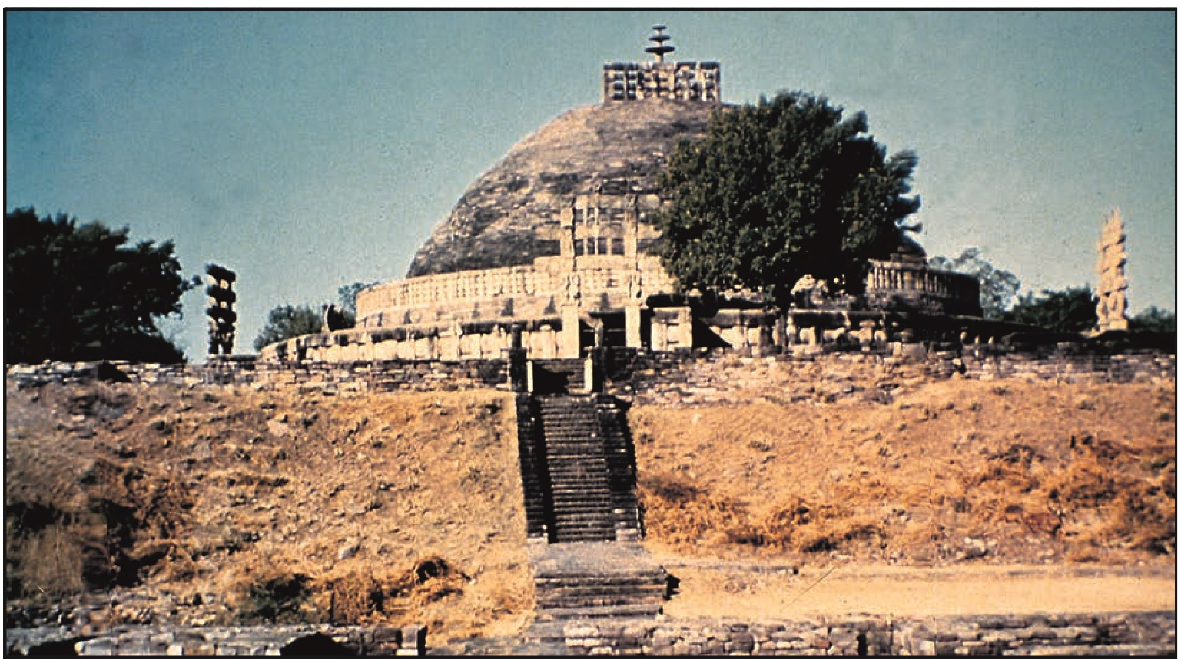
(For Visually Impaired Candidates, in lieu of Q7: In which of the following modern states of India is Sanchi Stupa located? (A) Maharashtra (B) Madhya Pradesh (C) Tamil Nadu (D) Uttar Pradesh)
Solution
(B) Sanchi stupa. The picture shows the great stupa at Sanchi with its hemispherical dome (anda), railing and gateway. VI answer: (B) Madhya Pradesh (Sanchi is near Bhopal).
Assertion (A): Like Buddhism, Jainism spread to many parts of India. Reason (R): Jaina scholars produced literature in various languages such as Prakrit, Sanskrit and Tamil. (A) Both correct, R explains A (B) Both correct, R not explanation (C) A correct, R not (D) A not correct, R correct
Solution
(A) as per the board key: Jaina texts in many languages helped the tradition reach different regions.
Which are teachings of the Buddha? I. The world is transient and constantly changing II. It is soulless; nothing is eternal III. Sorrow is intrinsic to human existence IV. Renouncing the world is essential for living. (A) I, II, III (B) II, III, IV (C) I, III, IV (D) I, II, IV
Solution
(A) I, II and III. The Buddha taught a middle path of moderation, not compulsory renunciation for all.
Identify the sculptural panel in the image: (A) Brihadeswara (B) Mahabalipuram (C) Amaravati (D) Sanchi. [VI: In which state is Mahabalipuram? (C) Tamil Nadu]
Solution
(B) A sculpture from Mahabalipuram (the great rock relief). VI answer: (C) Tamil Nadu.
Identify the school of art of the Bodhisatta image: (A) Gandhara (B) Mathura (C) Amaravati (D) Sarnath. [VI: Which ruler of Bhopal gave money to preserve Sanchi? (C) Shahjehan Begum]
Solution
(A) Gandhara. VI answer: (C) Shahjehan Begum.
Locate and label Amaravati, a Buddhist site.
Solution
Amaravati: Andhra Pradesh, on the river Krishna (Guntur district), known for its stupa.
Identify the school of art of the first-century CE Buddha image: (A) Gandhara (B) Amaravati (C) Sarnath (D) Mathura. [VI: another name for Hinayana Buddhism? (C) Theravada]
Solution
(D) Mathura (the Buddha image from Mathura, c. first century CE). VI answer: (C) Theravada.
Locate and label Nagarjunakonda, an ancient Buddhist site.
Solution
Nagarjunakonda: Palnadu district, Andhra Pradesh, on the river Krishna (now an island in the Nagarjuna Sagar reservoir).
Identify the queen (image) who helped preserve the Sanchi stupa: (A) Sultan Jehan Begum (B) Shahjehan Begum (C) Sikandar Begum (D) Qudsia Begum. [VI: In which state are the Ajanta paintings? (D) Maharashtra]
Solution
(B) Shahjehan Begum (ruler of Bhopal 1868–1901; NCERT shows her picture). Her successor Sultan Jehan Begum also gave money. VI answer: (D) Maharashtra.
Who persuaded the Buddha to admit women into the sangha? (A) Mahapajapati Gotami (B) Rahula (C) Ananda (D) Punna
Solution
(C) Ananda, his dear disciple; the Buddha's foster mother Mahapajapati Gotami became the first woman ordained (bhikkhuni).
Locate and label Ajanta, a Buddhist site (VI: one Buddhist site in Maharashtra).
Solution
Ajanta: Aurangabad (Chhatrapati Sambhajinagar) district of Maharashtra; rock-cut Buddhist caves with paintings.
Two statements have been given below as Assertion (A) and Reason (R). Read the statements and choose the appropriate answer:
Assertion (A): Buddhism grew rapidly both during the lifetime and after the death of Buddha.
Reason (R): Many people were dissatisfied with existing religious practices and confused by the rapid social changes taking place around them.
Solution
(A): the Buddha's teaching appealed to people dissatisfied with rituals and unsettled by rapid social change, so it spread quickly.
Consider the following statements regarding Jainism and choose the correct option:
I. The cycle of birth and rebirth is shaped through Karma.
II. There is a need to renounce the world.
III. Worldly existence is a necessary condition for attaining salvation.
IV. Principle of Ahimsa is important.
Solution
(C) I, II and IV. Jainas held that one must renounce worldly existence (asceticism and penance) to escape karma; III is wrong.
The following picture shows the structure of a temple carved out of single piece of rock. Identify this temple correctly from the given options:
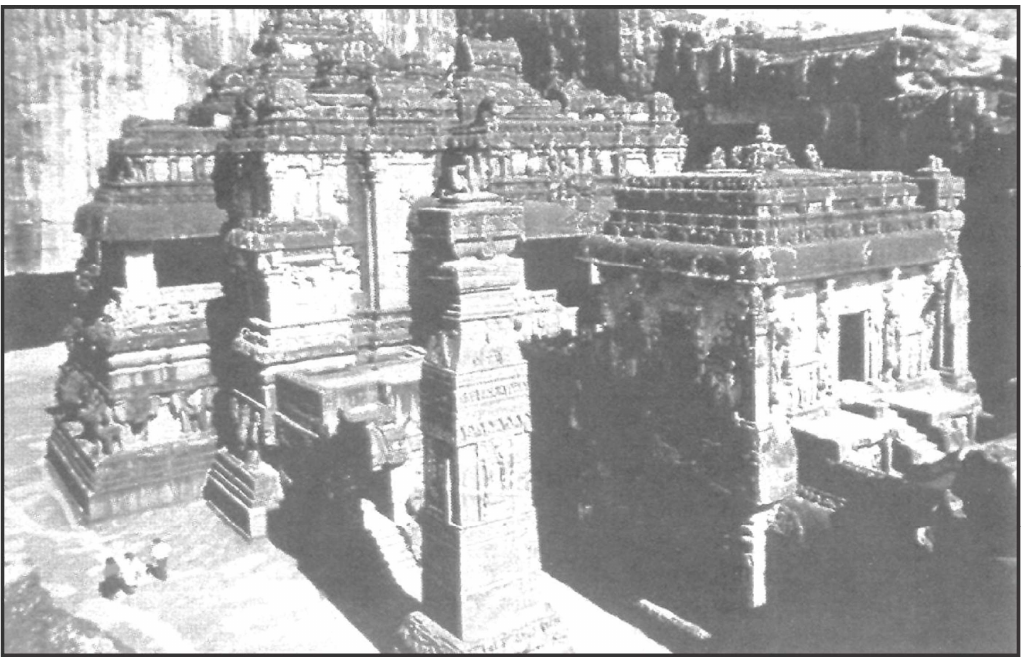
(For Visually Impaired Candidates, in lieu of Q7: In which of the following states Kailashnatha Temple is located? (A) Uttar Pradesh (B) Tamil Nadu (C) Maharashtra (D) Andhra Pradesh)
Solution
(B) Kailashnatha temple at Ellora, Maharashtra (VI answer: (C) Maharashtra), carved out of a single rock in the eighth century.
(ii) Amravati – a Buddhist site
Solution
Amaravati: Andhra Pradesh, on the river Krishna (Guntur district), known for its stupa.
Match the Sanchi sculptures with their meaning: a. Empty seat b. Gajalakshmi c. Wheel d. Shalabhanjika — i. Mahaparinibbana ii. Good fortune iii. Auspicious iv. First sermon of the Buddha. (A) i ii iv iii (B) ii iii i iv (C) ii i iv iii (D) iv i iii ii
Solution
Intended answer (A): Gajalakshmi – good fortune, wheel – first sermon (dhamma-chakra), shalabhanjika – auspicious. But per NCERT the empty seat stands for the Buddha's meditation (the stupa represents the mahaparinibbana), which is not in Column II, so the board awarded the mark to every candidate who attempted it.
Identify the ruler: ruler of Bhopal, ruled 1868–1901, helped preserve the Sanchi stupa. (A) Jahanara Begum (B) Shahjehan Begum (C) Gulbadan Begum (D) Rukhsaar Begum
Solution
(B) Shahjehan Begum. She and her successor Sultan Jehan Begum gave money to preserve Sanchi; Sultan Jehan funded the museum and guesthouse there.
The fifth-century sculpture from the Deogarh temple depicts which deity? (A) Indra (B) Shiva (C) Rudra (D) Vishnu. [VI: Vardhamana Mahavira is related to which religion? (D) Jainism]
Solution
(D) Vishnu, reclining on the serpent Sheshnag (Deogarh, UP). VI answer: (D) Jainism.
Assertion (A): The Tripitaka in Pali is one of the primary collections of Buddhist scriptures. Reason (R): It consists of three collections: Vinaya Pitaka, Sutta Pitaka and Abhidhamma Pitaka. (A) Both true, R explains A (B) Both true, R does not explain A (C) A true, R false (D) A false, R true
Solution
(A) Tripitaka means "three baskets": Vinaya (rules for monks and nuns), Sutta (the Buddha's teachings) and Abhidhamma (philosophy).
In Jainism, severe asceticism and non-attachment are meant to achieve ___, liberation from the cycle of birth and death. (A) Ahimsa (B) Karma (C) Moksha (D) Dharma
Solution
(C) Moksha.
Locate and label Sanchi, a stupa. (VI: any two ancient Buddhist sites in the Deccan.)
Solution
Sanchi: Raisen district of Madhya Pradesh, near Bhopal (Vidisha). VI: Amaravati, Nagarjunakonda, Ajanta, Karle, Bhaja, Kanheri.
Match Buddhist texts with descriptions: a. Vinaya Pitaka b. Abhidhamma Pitaka c. Dipavamsa d. Mahavamsa — i. rules for the monastic order ii. chronicle of the island iii. regional histories of Buddhism iv. philosophical matters. (A) a-iii b-i c-ii d-iv (B) a-iii b-iv c-i d-ii (C) a-i b-ii c-iii d-iv (D) a-i b-iv c-ii d-iii
Solution
(D) Vinaya – rules for the sangha; Abhidhamma – philosophy; Dipavamsa ("chronicle of the island") and Mahavamsa ("great chronicle") of Sri Lanka contain regional histories of Buddhism.
The Bodhisatta (Bodhisattva) statue in the picture is influenced by which school of art? (A) Mathura (B) Gandhara (C) Amaravati (D) Nalanda. [VI: Where are the Barabar caves? (C) Bihar]
Solution
(B) Gandhara (Taxila/Peshawar region), whose sculptures show Indo-Greek influence. VI answer: (C) Bihar (Gaya district; rock-cut caves made for the Ajivikas).
Locate and label Amaravati, a stupa. (VI: two ancient Buddhist sites in central India.)
Solution
Amaravati: Guntur district, Andhra Pradesh, on the Krishna. VI: Sanchi, Bharhut (Madhya Pradesh).
Odd one out regarding Buddhist texts: (A) Dipavamsa, Mahavamsa, Sutta Pitaka (B) Sutta, Abhidhamma, Vinaya Pitaka (C) Ashokavadana, Mahavamsa, Jatakas (D) Uttaradhyayana Sutta, Sutta Pitaka, Vinaya Pitaka
Where is the lion capital of the Ashokan pillar (picture) located? (A) Lumbini (B) Sarnath (C) Bodh Gaya (D) Kushinagar. [VI: Ashoka belonged to which dynasty? (B) Maurya]
Assertion (A): Shahjehan Begum was a 19th-century patron known for her contribution to Sanchi's preservation. Reason (R): The Sanchi stupa is a classical example of early Buddhist architecture. (A) Both true, R explains A (B) Both true, R not explanation (C) A true, R false (D) A false, R true
In Jaina philosophy, the cycle of birth and rebirth is shaped by ___. (A) Dharma (B) Moksha (C) Karma (D) Ahimsa
Locate and label Bodh Gaya, an ancient Buddhist site. (VI: any two pillar inscriptions of Ashoka.)
Sushruta's book 'Sushruta Samhita' is based on which of the following theme?
Match Column I with Column II and choose the correct option:
| Column I (Sculpture of Sanchi) | Column II (Symbolism) |
|---|---|
| 1. Empty Seat | (i) Symbol of good fortune |
| 2. Wheel | (ii) Auspicious symbol |
| 3. Shalabhanjika | (iii) First sermon of Buddha |
| 4. Gajalakshmi | (iv) Mahaparinibbana |
Identify the school of art with the help of the given image of Buddha.
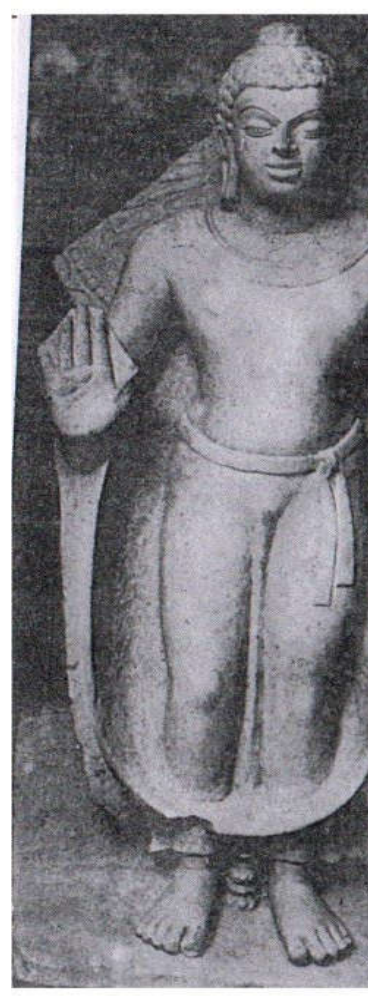
(For Visually Impaired Candidates, in lieu of Q6: Which of the following clans did Buddha belong to? (A) Sakya (B) Kosala (C) Bhoja (D) Pala)
(ii) Amravati stupa
Panini's Ashtadhyayi is on: (A) Puranas (B) grammar (C) mathematics (D) medicine
Match temples with locations: 1. Deogarh 2. Mahabalipuram 3. Kailashnatha 4. Barabar — (i) Tamil Nadu (ii) Maharashtra (iii) Bihar (iv) Uttar Pradesh. (A) 1-i 2-ii 3-iii 4-iv (B) 1-ii 2-iii 3-iv 4-i (C) 1-iv 2-i 3-ii 4-iii (D) 1-iii 2-iv 3-i 4-ii
Identify the feature marked "A" of the Sanchi stupa: (A) harmika (B) yashti (C) chhatri (D) anda. [VI: Which stupa is near Bhopal, MP? (C) Sanchi]
Which school of art does the Buddha image show? (A) Amaravati (B) Mathura (C) Gandhara (D) Gothic. [VI: In which text were the Buddha's teachings compiled? (B) Sutta Pitaka]
Identify the ancient temple in the image: (A) Deogarh (B) Kailashnatha (C) Brihadeshwara (D) Mahabalipuram. [VI: Which ancient scholar belonged to Greece? (C) Aristotle]
The Buddha's first sermon was delivered at ___. (A) Bodh Gaya (B) Amaravati (C) Sarnath (D) Sanchi
Identify the person in the picture: (A) Sultan Jehan Begum (B) Shahjehan Begum (C) Jahanara Begum (D) Rukhsar Begum. [VI: Sanchi stupa is in which state? (B) Madhya Pradesh]
Assertion (A): In the eighth century the Kailashnatha temple was carved out of a mountain. Reason (R): Ashoka had ordered artificial caves to be cut into mountains resembling temples. (A) Both true, R explains A (B) Both true, R not explanation (C) A true, R untrue (D) A untrue, R true
Locate and label Bharhut, a Buddhist site.
Which one of the following is not a structural feature of Stupa?
In which state of India is the fifth century temple, Devgarh situated?
The Buddha's foster mother, Mahapajapati Gotami was the first woman to be ordained as a _________.
What was the last message of the Buddha to his followers?
Which one of the following texts contains the teachings of Mahavira or Jaina Philosophy?
Identify the following image and give it an appropriate title:
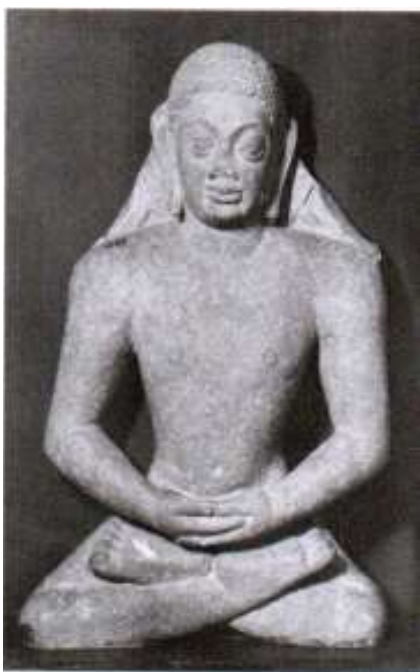
(For Visually Impaired Candidates, in lieu of Q6: Buddha's teachings have been reconstructed from stories found mainly in _________, one of the texts of Tipitaka.)
Study the following statements regarding Buddhism carefully:
I. Buddhism grew rapidly, both during the lifetime and after the death of Buddha.
II. Buddhism did not give much importance to conduct and values.
III. Buddhism appealed to many people who were dissatisfied with the existing religious practices.
IV. Buddhism laid much stress on superiority based on birth.
Which of the above statements are correct?
2 marks: very short answer
Why are Buddhist Stupas said to be stories in stone? Explain.
Solution
(1) The railings and gateways of stupas such as Sanchi are covered with sculptures that narrate stories from the Jatakas and from the Buddha's life; for example, a scene of a rustic village with thatched huts and trees is identified as the Vessantara Jataka. (2) The Buddha's life is shown through symbols: the empty seat (meditation), the stupa (mahaparinibbana), the wheel (the first sermon at Sarnath) and the bodhi tree; so the sculpted stones "tell" stories to those who can read the symbols, which is why stupas are called stories in stone.
3 marks: short answer
Explain the causes of the ruin of Stupa at Amravati.
Solution
(1) Amaravati was discovered in 1796 by a local raja who wanted to build a temple and took stone from it, thinking it was a treasure site. (2) In 1854 Walter Elliot, commissioner of Guntur, collected sculpture panels and took them to Madras ("Elliot marbles"); others were taken to Calcutta, Madras and London, and some decorated local temples or gardens. (3) Officials then believed antiquities should be taken away; H.H. Cole's view that they should be preserved where found came too late for Amaravati (unlike Sanchi, which survived in situ).
Explain the significance of Pauranic Hinduism of the ancient India.
Solution
(1) It developed Vaishnavism and Shaivism, centred on devotion (bhakti) to a chosen deity, a bond of love open to all. (2) Through images, temples, avatars and Puranic stories in simple Sanskrit (heard by women and Shudras too) it spread widely and absorbed local beliefs. (3) It shaped temple architecture (garbhagriha, shikhara) and religious practice that continued for centuries.
How did the Buddha attain enlightenment? Explain.
Solution
(1) Siddhartha, prince of the Shakya clan, led a sheltered life until he saw an old man, a sick man, a corpse and a renouncer; he resolved to find a way of salvation. (2) He left the palace and explored various paths: meditation and severe austerities, but rejected extreme penance. (3) After meditating for several days under a peepal (bodhi) tree at Bodh Gaya he attained enlightenment and came to be known as the Buddha, the Enlightened One.
How has Buddhist literature helped in understanding the sculpture of Sanchi? Explain.
Solution
(1) The Buddha was not shown in human form in early sculpture; by comparing sculptures with textual traditions (the Jatakas and life stories) historians identified symbols: empty seat, stupa, wheel, tree. (2) A panel showing a scene of villagers with thatched huts and trees was identified as the Vessantara Jataka. (3) Other motifs (shalabhanjika, Gajalakshmi) did not come from Buddhist texts but from popular traditions, showing that texts alone cannot explain everything.
"The mid-first millennium BCE is considered as a significant turning point in the course of World History." Justify the statement.
Solution
(1) Thinkers emerged across the world: Zarathustra in Iran, Kong Zi (Confucius) in China, Socrates, Plato and Aristotle in Greece, and Mahavira and the Buddha in India. (2) They tried to understand the mysteries of existence and the relationship between humans and the cosmic order. (3) It was also a time of new kingdoms (mahajanapadas) and cities, changing social and economic life with iron tools, expanding agriculture and punch-marked coins, which shaped the new systems of thought.
How does the Sanchi stupa reflect the religious and cultural beliefs of ancient India? Explain with examples.
How did Puranic Hinduism contribute to the development of Vaishnavism and Shaivism? Explain.
"According to Jaina teachings, birth and rebirth are shaped through karma." Explain.
On the same political outline map of India, three places which are major Buddhist sites have been marked as A, B and C. Identify them and write their correct names on the lines drawn near them.
(For Visually Impaired Candidates, in lieu of Q17: 17.1 Name any one centre of National Movement. 17.2 Name any one territory under Babur. 17.3 Name any three Buddhist sites.)
4 marks: case-based / source-based
Source: Verses from the Upanishads (Chhandogya Upanishad: the self within the heart is smaller than a grain of millet and greater than the earth, heaven and all worlds; the wind that blows is the true sacrifice).
31.1 Where does the soul reside according to the verse? (1) 31.2 How is the soul described in terms of size? (1) 31.3 What happens when a person truly knows the self? (2)
Solution
31.1 Within the heart.
31.2 As both very small (smaller than a kernel of millet) and very great (greater than the earth, sky and all worlds), i.e. both tiny and infinite.
31.3 (i) He realises the self is one with the ultimate reality (Brahman), greater than all the worlds. (ii) He is freed from ignorance and the cycle of birth and death and attains liberation; knowledge of the self, not ritual, is the true path.
Source: How Buddhist texts were prepared and preserved — the Buddha taught orally through discussion; none of his speeches were written in his lifetime; after his death his teachings were compiled at a council of elders at Vesali (Vaishali) into the Tipitaka (three baskets), transmitted orally and later written; Vinaya Pitaka (rules for the sangha), Sutta Pitaka (the Buddha's teachings), Abhidhamma Pitaka (philosophy); Dipavamsa and Mahavamsa (Sri Lanka); pilgrims Fa Xian and Xuan Zang took texts to China; texts preserved in monasteries across Asia.
31.1 Why were the Buddha's speeches not written down in his lifetime? (1) 31.2 Impact of transmitting texts orally before writing them. (1) 31.3 Differences between the Vinaya and Sutta Pitakas. (2)
Solution
31.1 He taught orally through discussion and debate; the tradition of the time was oral, and teachings were memorised and discussed.
31.2 It preserved teachings through memory and allowed wide spread among listeners, but versions could change, so councils later compiled and fixed them in writing.
31.3 (i) The Vinaya Pitaka contains rules and regulations for monks and nuns in the sangha. (ii) The Sutta Pitaka contains the Buddha's teachings (discourses).
Source: Verses from the Upanishads — two verses from the Chhandogya Upanishad (Sanskrit, c. sixth century BCE). The Nature of the Self: "This self of mine within the heart is smaller than paddy or barley or mustard or millet … greater than the earth, greater than the intermediate space, greater than heaven, greater than these worlds." The True Sacrifice: "This one (the wind) that blows, this is surely a sacrifice … While moving, it sanctifies all this; therefore it is indeed a sacrifice."
31.1 Main theme of the verses. (1) 31.2 Relationship between the self and the wind in these verses. (1) 31.3 How does the source reflect the philosophical ideas of the Upanishads? (2)
Solution
31.1 The nature of the self (atman) and of true sacrifice.
31.2 Both are presented as transformative forces: the self within is all-encompassing, and the wind, by moving, sanctifies everything, so it is the true sacrifice (not a ritual).
31.3 (i) The Upanishads questioned rituals and sought the meaning of life, the possibility of life after death and rebirth. (ii) They focused on the nature of the ultimate reality and the self, a spiritual path of knowledge rather than sacrifice.
Read the given source carefully and answer the questions that follow:
Buddhism in practice
This is an excerpt from the Sutta Pitaka, and contains the advice given by the Buddha to a wealthy householder named Sigala:
In five ways should a master look after his servants and employees … by assigning them work according to their strength, by supplying them with food and wages, by tending them in sickness; by sharing delicacies with them and by granting leave at times…
In five ways should the clansmen look after the needs of samanas (those who have renounced the world) and Brahmanas: by affection in act and speech and mind, by keeping open house to them and supplying their worldly needs.
There are similar instructions to Sigala about how to behave with his parents, teacher and wife.
31.1 How did Buddha highlight the significance of compassion in social hierarchy? (1)
31.2 Why did Buddha emphasise righteous action? (1)
31.3 Explain any two tenets of Karma according to Buddha. (2)
Solution
31.1 Even masters were to treat servants with care: work according to strength, food, wages, care in sickness and leave.
31.2 He believed that individual effort and righteous conduct could transform social relations and free people from suffering, rather than birth or rituals.
31.3 (i) Every action has consequences; good actions lead to better rebirth and bad ones to suffering. (ii) By righteous action and moderation one can break the cycle of rebirth and attain nibbana (self-realisation).
Source: Fatalists and materialists? — from the Sutta Pitaka: King Ajatasattu told the Buddha what Makkhali Gosala taught: neither the wise nor the fool can change karma by virtue or penance; pleasure and pain are measured out and cannot be altered in samsara; like a ball of string unwinding, fool and wise alike take their course and make an end of sorrow. Ajita Kesakambalin taught: there is no alms, sacrifice or offering, no this world or the next; a human is made of four elements; at death earth returns to earth, fluid to water, heat to fire, windy to air, senses into space; gifts are a doctrine of fools; fools and wise alike perish. Gosala belonged to the Ajivikas (fatalists), Ajita to the Lokayatas (materialists); their own texts have not survived.
31.1 Analyse Makkhali Gosala's views on karma. (1) 31.2 How did Ajita describe the relation of humans with the four elements? (1) 31.3 Differentiate between a fatalist and a materialist. (2)
Source: Buddhism in practice (the Buddha's advice to the householder Sigala on looking after servants and employees, samanas and Brahmanas, with similar advice on parents, teacher and wife; see above).
31.1 Explain the significance of the Sutta Pitaka in Buddhism. (1) 31.2 How did the Buddha advise wealthy householders to be humane and ethical? (1) 31.3 What was his advice to Sigala on behaving with parents and teachers? (2)
How was the fate of Amravati stupa different from the Sanchi stupa? Explain.
8 marks: long answer
Describe the teachings and principles of Buddhism.
Solution
(1) Siddhartha (Gautama), born a prince of the Shakya clan, renounced worldly life after seeing an old man, a sick man, a corpse and a renouncer; after meditation he attained enlightenment and taught for the rest of his life. (2) The world is transient (anicca) and constantly changing; it is soulless (anatta), and nothing is permanent; sorrow (dukkha) is intrinsic to existence. (3) By following the path of moderation between severe penance and self-indulgence, people could rise above worldly troubles. (4) He regarded the existence of god as irrelevant. (5) Social world was a creation of humans, not of divine origin; kings and gahapatis were advised to be humane and ethical; individual effort could transform social relations. (6) He emphasised individual agency and righteous action (karma) as the means to escape the cycle of rebirth and attain nibbana, the extinguishing of the ego and desire. (7) He founded the sangha, a community of monks (and later nuns, after Ananda's request on behalf of Mahapajapati Gotami) who lived simply, possessing only essentials. (8) His teachings, recorded in the Tripitaka and transmitted orally, spread widely because they appealed to people dissatisfied with ritualism and social change; Buddhism later spread to Sri Lanka, Central Asia and East Asia.
Describe the main ideas of Jainism and its spread across India in the ancient period.
Solution
(1) The basic philosophy of the Jainas existed in north India before Vardhamana Mahavira (sixth century BCE); he was the 24th and last tirthankara (those who guide men and women across the river of existence). (2) The entire world is animated: even stones, rocks and water have life. (3) Non-injury (ahimsa) to living beings, especially humans, animals, plants and insects, is central; this has permeated Indian thinking. (4) The cycle of birth and rebirth is shaped through karma. (5) Asceticism and penance are required to free oneself from the cycle of karma; this is possible only by renouncing the world, so one must live in a monastery to attain salvation. (6) Monks and nuns took five vows: not to kill, steal or lie, to observe celibacy and not to possess property. (7) Spread: gradually Jainism spread to many parts of India; like Buddhists, Jaina scholars produced a wealth of literature in various languages: Prakrit, Sanskrit and Tamil; for centuries manuscripts were preserved in libraries attached to temples. (8) Some of the earliest stone sculptures associated with religious traditions were produced by devotees of the Jaina tirthankaras, recovered from several sites throughout the subcontinent (e.g. Mathura).
Examine how sculptural elements are integrated within the architectural framework of the Sanchi stupa.
Solution
(1) The stupa (from the Sanskrit for "heap") began as a simple semicircular mound (anda) containing relics, topped by the harmika (balcony-like structure, abode of the gods), a mast (yashti) and a chhatri (umbrella). (2) A railing (vedika) separated the sacred space; the Sanchi railings and four gateways (toranas) facing the cardinal directions were richly carved. (3) Devotees entered from the east gateway and walked clockwise (pradakshina), keeping the mound on the right, imitating the sun's course. (4) The sculptures show the Buddha through symbols: empty seat (meditation), stupa (mahaparinibbana), wheel (first sermon), tree (enlightenment). (5) Jataka stories are carved, e.g. the Vessantara Jataka (a generous prince) on the north gateway. (6) Popular traditions were absorbed: shalabhanjika (woman holding a tree branch, auspicious), Gajalakshmi (goddess of good fortune flanked by elephants), animals and nature motifs, yakshas and nagas. (7) Inscriptions on railings record donors (monks, nuns, merchants, women, ivory workers of Vidisha), linking art with collective patronage. (8) Thus sculpture and architecture together taught Buddhist ideas to devotees and made the stupa a living sacred space.
Examine the relationship between Puranic Hinduism and devotional practices.
Solution
(1) From the early centuries CE, Puranic Hinduism grew around the worship of Vishnu (Vaishnavism) and Shiva (Shaivism), in which devotion (bhakti) to a chosen deity was central. (2) Devotion meant a bond of love and devotion between the devotee and god, open to all regardless of caste or gender. (3) Vishnu was believed to take avatars (ten incarnations) to save the world when disorder and destruction threatened, e.g. Varaha (boar) raising the earth goddess. (4) Gods were worshipped through images: Shiva as a linga, Vishnu in various forms, goddesses like Durga; many images used symbols (e.g. Shiva's matted hair and third eye). (5) The Puranas, compiled by Brahmanas from c. third century CE, told stories of gods and goddesses in simple Sanskrit verse, meant to be read aloud and heard by everybody, including women and Shudras. (6) Many stories evolved through interaction between people: priests, merchants, ordinary men and women, so local beliefs were integrated. (7) Temples housed the images: early ones were small square rooms (garbhagriha) with a doorway, later with a tall shikhara; e.g. the Deogarh temple (fifth century) and rock-cut temples like Kailashnatha at Ellora. (8) Devotional practice included pilgrimage, temple worship, festivals and hymns; it reshaped religion into a more personal and inclusive form.
"The Buddha was one of the most influential teachers of his time." Explain his teachings.
Solution
(1) Siddhartha (Gautama), born a prince of the Shakya clan, renounced worldly life after seeing an old man, a sick man, a corpse and a renouncer; after meditation he attained enlightenment and taught for the rest of his life. (2) The world is transient (anicca) and constantly changing; it is soulless (anatta), and nothing is permanent; sorrow (dukkha) is intrinsic to existence. (3) By following the path of moderation between severe penance and self-indulgence, people could rise above worldly troubles. (4) He regarded the existence of god as irrelevant. (5) Social world was a creation of humans, not of divine origin; kings and gahapatis were advised to be humane and ethical; individual effort could transform social relations. (6) He emphasised individual agency and righteous action (karma) as the means to escape the cycle of rebirth and attain nibbana, the extinguishing of the ego and desire. (7) He founded the sangha, a community of monks (and later nuns, after Ananda's request on behalf of Mahapajapati Gotami) who lived simply, possessing only essentials. (8) His teachings, recorded in the Tripitaka and transmitted orally, spread widely because they appealed to people dissatisfied with ritualism and social change; Buddhism later spread to Sri Lanka, Central Asia and East Asia.
Explain the features of Puranic Hinduism.
Solution
(1) Puranic Hinduism grew around Vaishnavism (Vishnu as the chief deity) and Shaivism (Shiva as the chief god). (2) Worship emphasised a bond of devotion (bhakti) and love between the devotee and the god. (3) Vishnu's ten avatars came to restore order; some avatars may represent local deities absorbed. (4) Deities were represented in images (Shiva as linga; Vishnu in human form) with symbolic features. (5) The Puranas told stories of the gods in simple Sanskrit for all, including women and Shudras, to hear. (6) Local beliefs and practices were integrated through interaction of priests, merchants and ordinary people. (7) Temples developed: from small garbhagriha shrines to large structures with shikharas, halls and gateways (e.g. Deogarh; Kailashnatha, Ellora). (8) Ritual practices included pilgrimage, image worship and festivals, making religion more personal and widespread.
Examine the main features of the Sanchi stupa and the role of the rulers of Bhopal in preserving it. (5 + 3) (5 + 3)
Examine the major teachings of the Buddha and why Buddhism grew rapidly. (5 + 3)
"The Stupa at Sanchi is among the best preserved monuments of the earliest times." Explain the statement.
Explain the growth of Puranic Hinduism.
Trace out the growth of Buddhism. Explain the main teachings of Buddha. (4 + 4 = 8)
Trace out how stupas were built. Explain why the stupa at Sanchi survived, but not at Amravati. (4 + 4 = 8)
Get every solution for all chapters
- Every board question of every chapter, each fully solved the way the board gives marks
- 15 complete board papers, each followed by its solutions
- Weightage and most-asked topics for every chapter
- Instant PDF download, colour and black & white print copies
Revising the chapter first? Complete History Notes for Class 12 (CBSE 2026-27) →
What you get in the pack
- 10 years of CBSE Class 12 History board papers: 2016 to 2026 (all 143 sets, main and compartment; 15 in full)
- All 12 chapters and 15 full board papers complete
- Part A: all 12 chapters, questions sorted chapter-wise and by marks
- Year-wise weightage table and most-asked topics for every chapter
- Part B: each full board paper followed by its complete solutions
- Point-wise long answers, source-based answers and map locations
- Questions on topics out of the board syllabus are flagged
All chapters in this pack
- PYQ Ch 1 Bricks, Beads and Bones: The Harappan Civilisation
- PYQ Ch 2 Kings, Farmers and Towns: Early States and Economies
- PYQ Ch 3 Kinship, Caste and Class: Early Societies
- PYQ Ch 4 Thinkers, Beliefs and Buildings: Cultural Developments
- PYQ Ch 5 Through the Eyes of Travellers: Perceptions of Society
- PYQ Ch 6 Bhakti–Sufi Traditions
- PYQ Ch 7 An Imperial Capital: Vijayanagara
- PYQ Ch 8 Peasants, Zamindars and the State
- PYQ Ch 9 Colonialism and the Countryside
- PYQ Ch 10 Rebels and the Raj: The Revolt of 1857
- PYQ Ch 11 Mahatma Gandhi and the Nationalist Movement
- PYQ Ch 12 Framing the Constitution
- Board Paper 2026 Set 61-1-1 with Solutions
- Board Paper 2026 Set 61-1-2 with Solutions
- Board Paper 2026 Set 61-1-3 with Solutions
- Board Paper 2026 Set 61-2-1 with Solutions
- Board Paper 2025 Set 61-1-1 with Solutions
- Board Paper 2025 Set 61-2-1 with Solutions
- Board Paper 2024 Set 61-1-1 with Solutions
- Board Paper 2024 Set 61-2-1 with Solutions
- Board Paper 2023 Set 61-1-1 with Solutions
- Board Paper 2022 Term 2 Set 61-1-1 with Solutions
- Board Paper 2020 Set 61-1-1 with Solutions
- Board Paper 2019 Set 61-1-2 with Solutions
- Board Paper 2018 Set 61-1 with Solutions
- Board Paper 2017 Set 61-1 with Solutions
- Board Paper 2016 Set 61-1 with Solutions