
CBSE Class 12 History Question Paper 2026 (61/1/1) with Solutions
The complete CBSE Class 12 History board paper of 2026, Q.P. code 61/1/1: all 35 questions exactly as set, with marks. 21 solutions are free below. The Class 12 History PYQ Book: Solved Board Papers 2016-2026 (CBSE) solves all 15 papers in full and sorts every question chapter-wise.
Subject expert: Vikas Chandrawal, M.A. History · 8 years teaching


Question paper
Jump to: Question paperSolutions
2026 · Q.P. Code 61/1/1
Maximum marks: 80
Section A: Multiple choice questions (1 mark each)
Match the Column – I with Column – II and choose the correct option:
| Column – I (Harappan Sites) | Column – II (Present Location) |
|---|---|
| a. Manda | 1. Haryana |
| b. Kalibangan | 2. Gujarat |
| c. Rakhigarhi | 3. Rajasthan |
| d. Lothal | 4. Jammu |
Options (a, b, c, d):
Arrange the following in correct chronological order and choose the correct option:
I. Chalcolithic Age
II. Mesolithic Age
III. Neolithic Age
IV. Paleolithic Age
Which one of the following is a work of Panini on Sanskrit grammar?
Which of the following pairs is correctly matched? (Ancient Dynasties – Lineage)
Fill in the blank with the appropriate option given below:
In the ancient period, each city had a history of its own, _________ began as a village but in fifth century B.C.E the Magadhan rulers shifted their capital from Rajagaha to this settlement.
Which of the following statements regarding Jainism is correct?
I. Vardhaman Mahavira was born in 5th Century CE.
II. Mahavira was the 24th Tirathankar.
III. Jains worship Lord Shiva as Mahavira.
IV. The principle of Ahimsa is emphasised in Jainism.
Identify the following structure from the options given below:
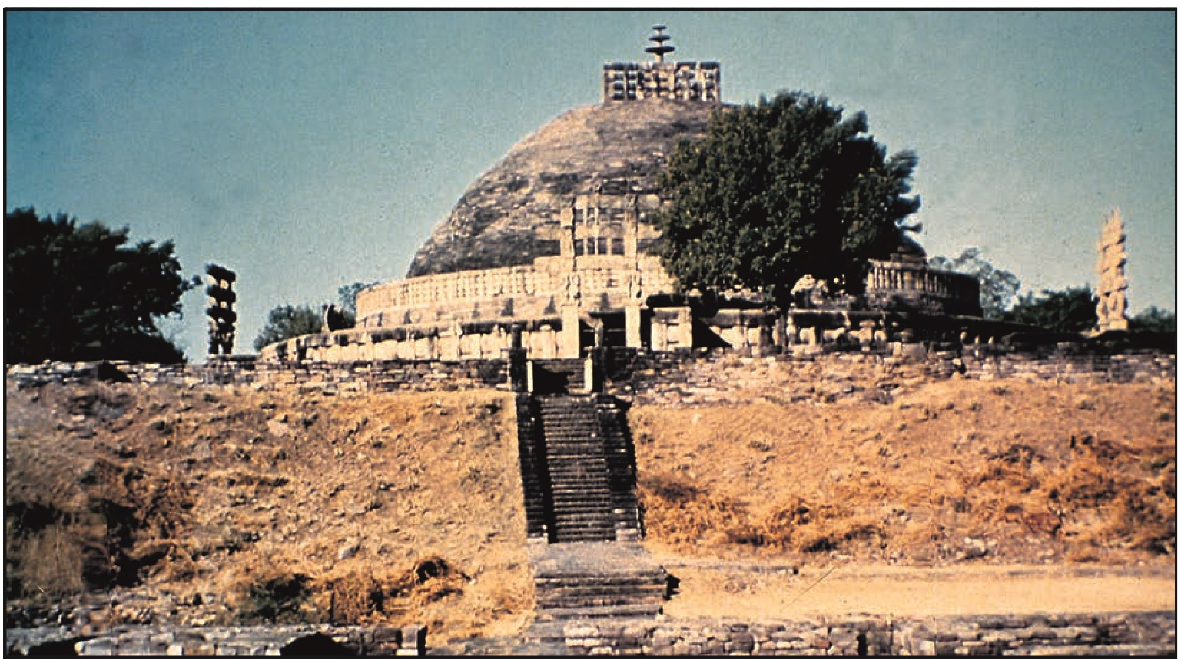
(For Visually Impaired Candidates, in lieu of Q7: In which of the following modern states of India is Sanchi Stupa located? (A) Maharashtra (B) Madhya Pradesh (C) Tamil Nadu (D) Uttar Pradesh)
Which of the following chronicles was authored by Abul-Fazl?
The battle at Talikota (Rakshasi Tangri) was fought between which two of the following groups?
Which of the following temples at Vijayanagara was meant to be used only by the king and his family?
Identify the foreign traveller with the help of the following information:
• He was Moroccan traveller of the 14th century.
• He had the expertise of Islamic religion law.
• He was appointed Qazi of Delhi by Muhammad bin Tughlaq
Who among the following is the author of the book of travels called 'Travels in the Mughal Empire'?
Find the odd one out from the following: (Sufi Teachers – Location of Dargah)
Two statements as Assertion (A) and Reason (R) are given below. Read them carefully and choose the correct option:
Assertion (A): Baba Guru Nanak Devji advocated Nirguna Bhakti.
Reason (R): For Baba Guru Nanak, the absolute or 'rab' had no gender or form.
Which of the following statements accurately describe the conditions of Bombay-Deccan from 1840 to 1850?
I. There was significant agrarian expansion during this period.
II. Prices of the agricultural products were rising steadily.
III. There were frequent peasant uprisings due to economic distress.
IV. The agrarian landscape largely remained progressive.
Identify the major long-term consequence of the permanent settlement for the Indian peasantry from the following:
Who amongst the following American Presidents played a decisive role in the American War of Independence?
Why was the Revolt of 1857 viewed as a serious threat by the British? Choose the most appropriate option:
Choose the correct pair regarding the local leaders during the Revolt of 1857. (Local Leader – Region)
Identify the Indian Political Leader with the help of the following information:
I. He moved the 'Objectives resolution' in the Constituent Assembly.
II. He moved the resolution proposing that the National flag be a horizontal tricolor of saffron, white and dark green in equal proportions with a wheel of navy blue colour in the centre.
Match Column I with Column II and choose the correct option: List of Women members in the Constituent Assembly
| Column – I (Women member) | Column – II (Constituency) |
|---|---|
| I. Sarojini Naidu | a. Central Province |
| II. Hansa Mehta | b. Uttar Pradesh |
| III. Vijayalakshmi Pandit | c. Bihar |
| IV. Rajkumari Amrit Kaur | d. Bombay |
Options (I, II, III, IV):
Section B: Short answer (3 marks each)
Examine the major contribution of John Marshall as Director General of Archaeological Survey of India.
(a) Explain the causes of the ruin of Stupa at Amravati.
(b) Explain the significance of Pauranic Hinduism of the ancient India.
"Ibn Batuta was amazed by the efficiency of Indian postal system." Explain the statement with examples.
(a) Describe the significance of Kamalpuram tank and Hiriya Canal as sources of water for the Vijayanagara.
(b) Describe the views of Dominingo Paes on the city of Vijaynagara.
Analyse the measures taken by the British to suppress the riots of Bombay-Deccan in 1875.
Explain the main provisions of the Government of India Act, 1935.
Section C: Long answer (8 marks each)
(a) "Although epigraphy is an important source of reconstructing history yet there are limits to what it can reveal." Justify the statement with suitable arguments.
(b) "Historians have used a variety of sources to reconstruct the history of the Mauryan empire and also explained the ways of their administration." Justify the statement with suitable arguments. (5 + 3 = 8)
(a) Explain the development of agriculture during Mughal period.
(b) Explain the role of women in the Agrarian society during 16th and 17th centuries.
(a) "Non-Cooperation Movement became an epoch in the life of Mahatma Gandhi and that of India." Explain the statement of Louis Fisher with examples.
(b) 'Gandhiji started the Salt March for various reasons and it resulted in a significant movement.' Explain the statement with examples. (4 + 4 = 8)
Section D: Source-based questions (4 marks each)
Read the given passage carefully and answer the questions that follow:
A Mother's Advice
The Mahabharata describes how, when war between the Kauravas and the Pandavas became almost inevitable, Gandhari made one last appeal to her eldest son Duryodhana.
By making peace you honour your father and me, as well as your well-wishers… it is the wise man in control of his senses who guards his kingdom. Greed and anger drag a man away from his profits; by defeating these two enemies a king conquers the earth… You will happily enjoy the earth, my son, along with the wise and heroic Pandavas…. There is no good in a war, no law (dharma) and profit (artha), let alone happiness; nor is there (necessarily) victory in the end – don't set your mind on war...
Duryodhana did not listen to this advice and fought and lost the war.
31.1 Explain the main cause of conflict between Kauravas and Pandavas. (1)
31.2 Why did Gandhari advice Duryodhana not to fight? (1)
31.3 Why did Duryodhana not listen to the advice of his mother, Gandhari? (2)
Read the following passage carefully and answer the questions that follows:
Declining a Royal Gift
This excerpt from a Sufi text describes the proceedings at Shaikh Nizamuddin Auliya's hospice in 1313:
I (the author, Amir Hasan Sijzi) has the good fortune of kissing his (Shaikh Nizamuddin Auliya's) feet… At this time a local ruler had sent him the deed of ownership to two gardens and much land, along with the provisions and tools for their maintenance. The ruler had also made it clear that he was relinquishing all his rights to both the gardens and land. The master…had not accepted that gift. Instead, he had lamented: "What have I to do with gardens and fields and lands?... None of …. our spiritual masters had engaged in such activity."
Then he told an appropriate story: "…. Sultan Ghiyasuddhin, who at that time was still known as Ulugh Khan, came to visit Shaikh Fariduddin (and) offered some money and ownership deeds for four villages to the Shaikh, the money being for the benefit of the dervishes (Sufis), and the land of his use. Smiling, Shaikh al Islam (Fariduddin) said: Give me the money. I will dispense it to the dervishes. But as for those land deeds, keep them. There are many who long for them. Give them away to such persons."
32.1 Mention the offering by the local ruler to Sufi saint. (1)
32.2 What was the reaction of Sufi saint on the offerings? (1)
32.3 Why did Sufi saint accept money? Explain. (2)
Read the given passage carefully and answer the following questions:
What taluqdars thought
The attitude of the taluqdars was best expressed by Hanwant Singh, the Raja of Kalakankar, near Rae Bareli. During the mutiny, Hanwant Singh had given shelter to a British officer, and conveyed him to safety. While taking leave of the officer, Hanwant Singh told him:
Sahib, your countrymen came into this country. You sent your officers round the districts to examine the titles to the estates. At one blow you took from me lands which from time immemorial had been in my family. I submitted. Suddenly misfortune fell upon you. The people of the land rose against you. You came to me whom you had despoiled. I have saved you. But now – now I march at the head of my retainers to Lucknow to try and drive you from the country.
33.1 Explain the anguish of Hanwant Singh for the British officer. (1)
33.2 How were Taluqdars facilitated by the rulers? (1)
33.3 Explain any two causes of dissatisfaction of Taluqdars from British rule. (2)
Section E: Map-based question (5 marks)
(i) On the given political outline map of India, locate and label the following with appropriate signs or symbols:
(i) Nageshwar – a mature Harappan site
(ii) Kashi – early state.
(iii) (a) Goa – an area under Aurangzeb
OR
(b) Thanjavur – a medieval town.
On the same map two places have been marked as centres of Indian national movement as A and B. Identify them and write their correct names on the lines drawn near them.
(For Visually Impaired Candidates, in lieu of Q34: 34.1 Name any two important capitals of the early states. 34.2 (a) Name one area which was under the rule of Aurangzeb. OR (b) Name the capital of Vijayanagara Empire. 34.3 Mention any two main centres of Indian National Movement.)
Solutions: CBSE 2026 · 61/1/1
(D) Manda – Jammu, Kalibangan – Rajasthan, Rakhigarhi – Haryana, Lothal – Gujarat.
(C) Ashtadhyayi. Panini's Ashtadhyayi (c. 5th–4th century BCE) is the classic grammar of Sanskrit. Sushruta Samhita is a medical text, Natyashastra (Bharata) a treatise on drama, and Abhijnanashakuntalam a play by Kalidasa.
(D) Pataliputra. Pataliputra began as a village, Pataligrama; in the fifth century BCE the Magadhan rulers shifted their capital from Rajagaha (Rajgir) to it, and it later became the Mauryan capital.
(B) Sanchi stupa. The picture shows the great stupa at Sanchi with its hemispherical dome (anda), railing and gateway. VI answer: (B) Madhya Pradesh (Sanchi is near Bhopal).
(D) In 1565 the combined armies of Bijapur, Ahmadnagar and Golconda routed Rama Raya.
(C) Ibn Battuta. The Moroccan traveller of the 14th century, learned in Islamic law (sharia), reached Delhi in 1333; Sultan Muhammad bin Tughlaq appointed him the qazi (judge) of Delhi.
(D) Nizamuddin Auliya's dargah is in Delhi (Ghiyaspur, on the Yamuna).
(C) Only I and II. By the 1840s there was modest agrarian expansion and after 1845 prices recovered steadily, so cultivators extended acreage (though the burden of debt remained).
(D) George Washington, commander of the American forces (later the first President).
(A) Gonoo – Chotanagpur (Singhbhum). Shah Mal – Baraut; Kunwar Singh – Arrah; Ahmadullah Shah – Lucknow/Faizabad.
(B) Sarojini Naidu – Bihar, Hansa Mehta – Bombay, Vijayalakshmi Pandit – United Provinces, Amrit Kaur – Central Provinces.
(1) Amaravati was discovered in 1796 by a local raja who wanted to build a temple and took stone from it, thinking it was a treasure site. (2) In 1854 Walter Elliot, commissioner of Guntur, collected sculpture panels and took them to Madras ("Elliot marbles"); others were taken to Calcutta, Madras and London, and some decorated local temples or gardens. (3) Officials then believed antiquities should be taken away; H.H. Cole's view that they should be preserved where found came too late for Amaravati (unlike Sanchi, which survived in situ).
(1) There were two kinds of post: the horse post (uluq), with royal horses stationed every four miles, and the foot post (dawa), with three stations per mile. (2) In the foot post, a runner carried a rod with copper bells and ran to the next station, where another was ready to take the letter; so news travelled very fast. (3) The foot post was quicker than the horse post; it took only five days for news to reach Delhi from Sind, and it was used to send fruit from Khurasan; the system helped merchants send news and credit and transport goods.
(1) The Portuguese visitor Paes (16th century) described the city as "as large as Rome and very beautiful to the sight", with many groves of trees, gardens and water conduits. (2) He described the fortifications: walls enclosing the city and agricultural tracts, and the bazaars full of goods, where precious stones (diamonds, rubies, pearls) were sold. (3) He described the Mahanavami festival, the king's grandeur, the royal centre and the abundant provisions, showing a prosperous capital.
(1) It extended provincial autonomy: elected Indian ministers controlled provincial subjects. (2) It proposed an all-India federation of provinces and princely states, with three lists of subjects (federal, provincial, concurrent). (3) It extended the franchise (to about 10–15% of adults) and kept separate electorates; elections to provincial legislatures under it (1937) gave the Congress governments in 8 of 11 provinces. Much of its framework (lists, governor's powers) was used in the Constitution.
Sources (5): (1) archaeological finds, especially sculpture; (2) contemporary works: Megasthenes's Indica (in fragments) and Kautilya's Arthashastra (parts of it); (3) later Buddhist, Jaina and Puranic literature (e.g. Ashokavadana) and Sanskrit works; (4) Ashoka's inscriptions on rocks and pillars, the most valuable source; (5) punch-marked coins. Administration (3): (6) There were five major political centres: the capital Pataliputra and the provincial centres of Taxila, Ujjayini, Tosali and Suvarnagiri, all mentioned in Ashoka's inscriptions; control was strongest around the capital and the provincial centres, which were carefully chosen (Taxila and Ujjayini on trade routes, Suvarnagiri for gold mines). (7) Communication along land and river routes was vital; the army was huge (Megasthenes mentions a committee with six subcommittees for military activity: navy, transport, infantry, cavalry, chariots, elephants). (8) Ashoka appointed dhamma mahamattas to spread dhamma; the empire was diverse (Afghanistan to Orissa), so control was uneven.
(1) Women and men worked shoulder to shoulder in the fields: men tilled and ploughed, women sowed, weeded, threshed and winnowed. (2) With nucleated villages and individual peasant farms, the household was the basis of production. (3) Women spun yarn, sifted and kneaded clay for pottery and embroidered; the more commercialised the product, the greater the demand for women's labour. (4) Because women's labour was valued, marriages among peasants and artisans involved bride-price instead of dowry. (5) Remarriage was legitimate for divorced and widowed women. (6) Yet biases continued: menstruating women could not touch the plough or the potter's wheel in western India, and men headed households; women were kept under control by family and community. (7) Women petitioned the panchayat (in Rajasthan, Maharashtra) seeking justice, e.g. against husbands who neglected them; Hindu and Muslim women inherited zamindaris and sold them (18th-century Bengal: the Rajshahi zamindari was run by a woman). (8) High mortality from malnutrition and frequent childbirth meant a shortage of wives in peasant and artisan communities.
Reasons: (1) The salt tax and state monopoly over salt were hated by all, especially the poor; salt was a daily necessity. (2) Gandhiji wanted an issue that united all classes and regions. (3) It was a symbol of the injustice of British rule; Gandhiji's notice to Irwin was ignored. (4) After the Lahore session (1929) declared Purna Swaraj, a mass movement was needed. Results: (5) The march from Sabarmati to Dandi (12 March – 6 April 1930) drew huge crowds and press coverage. (6) Civil Disobedience spread across India: salt laws, forest laws broken; taxes withheld; foreign goods boycotted; women participated in large numbers. (7) The government arrested about 60,000 people, but had to negotiate: Gandhi–Irwin Pact (1931) and the Round Table Conferences. (8) The world became aware of the Indian struggle, and Gandhiji's non-violent method won wide sympathy.
32.1 Deeds of ownership of two gardens and much land, with provisions and tools for their upkeep.
32.2 He refused the gift, lamenting that his spiritual masters had never engaged in owning gardens, fields and lands.
32.3 (i) Money could be distributed to the dervishes and the needy (as futuh, charity) for the hospice's open kitchen. (ii) Land would tie the Sufi to worldly property and the state, whereas giving away money served people without accumulating wealth.
Nageshwar: Gujarat, on the coast of the Gulf of Kachchh (Jamnagar/Dwarka region), a shell-working site.
(a) Goa: west coast between Maharashtra and Karnataka. (b) Thanjavur: Tamil Nadu, in the Kaveri delta.
Get every solution for all 15 papers
- Every board question of every chapter, each fully solved the way the board gives marks
- 15 complete board papers, each followed by its solutions
- Weightage and most-asked topics for every chapter
- Instant PDF download, colour and black & white print copies
Revising the chapter first? Complete History Notes for Class 12 (CBSE 2026-27) →
What you get in the pack
- 10 years of CBSE Class 12 History board papers: 2016 to 2026 (all 143 sets, main and compartment; 15 in full)
- All 12 chapters and 15 full board papers complete
- Part A: all 12 chapters, questions sorted chapter-wise and by marks
- Year-wise weightage table and most-asked topics for every chapter
- Part B: each full board paper followed by its complete solutions
- Point-wise long answers, source-based answers and map locations
- Questions on topics out of the board syllabus are flagged
All chapters in this pack
- PYQ Ch 1 Bricks, Beads and Bones: The Harappan Civilisation
- PYQ Ch 2 Kings, Farmers and Towns: Early States and Economies
- PYQ Ch 3 Kinship, Caste and Class: Early Societies
- PYQ Ch 4 Thinkers, Beliefs and Buildings: Cultural Developments
- PYQ Ch 5 Through the Eyes of Travellers: Perceptions of Society
- PYQ Ch 6 Bhakti–Sufi Traditions
- PYQ Ch 7 An Imperial Capital: Vijayanagara
- PYQ Ch 8 Peasants, Zamindars and the State
- PYQ Ch 9 Colonialism and the Countryside
- PYQ Ch 10 Rebels and the Raj: The Revolt of 1857
- PYQ Ch 11 Mahatma Gandhi and the Nationalist Movement
- PYQ Ch 12 Framing the Constitution
- Board Paper 2026 Set 61-1-1 with Solutions
- Board Paper 2026 Set 61-1-2 with Solutions
- Board Paper 2026 Set 61-1-3 with Solutions
- Board Paper 2026 Set 61-2-1 with Solutions
- Board Paper 2025 Set 61-1-1 with Solutions
- Board Paper 2025 Set 61-2-1 with Solutions
- Board Paper 2024 Set 61-1-1 with Solutions
- Board Paper 2024 Set 61-2-1 with Solutions
- Board Paper 2023 Set 61-1-1 with Solutions
- Board Paper 2022 Term 2 Set 61-1-1 with Solutions
- Board Paper 2020 Set 61-1-1 with Solutions
- Board Paper 2019 Set 61-1-2 with Solutions
- Board Paper 2018 Set 61-1 with Solutions
- Board Paper 2017 Set 61-1 with Solutions
- Board Paper 2016 Set 61-1 with Solutions