
Haloalkanes and Haloarenes: Class 12 PYQs 2016–2026 with solutions
All 45 CBSE board questions asked from Haloalkanes and Haloarenes in 15 board papers, with the year, set and marks of each. 24 are solved free below. The Class 12 Chemistry PYQ Book: Solved Board Papers 2016-2026 (CBSE) has every solution, all chapters and 19 full board papers.
Subject expert: Dr. S.L. Verma, B.Sc. (Hons), M.Sc. Chemistry, PhD · 23+ years teaching

Free: NCERT solutions for Class 12 Chemistry →
Haloalkanes and Haloarenes: board weightage
Board weightage 2016–2026
| Year | 2016 | 2017 | 2018 | 2019 | 2020 | 2022 | 2023 | 2024 | 2025 | 2026 |
|---|---|---|---|---|---|---|---|---|---|---|
| Questions | 2 | 2 | 2 | 4 | 6 | – | 8 | 7 | 8 | 6 |
| Marks | 4 | 4 | 4 | 8 | 8 | – | 13 | 14 | 15 | 12 |
Most asked topics
45 questions from 15 papers. Repeated questions are shown once with every year they were asked.
1 mark: MCQ and Assertion–Reason
Which of the following is 'not' true about enantiomers?
Solution
Answer: (B)
Enantiomers rotate plane-polarised light by equal amounts but in opposite directions, so their specific rotations are equal in magnitude and opposite in sign. Their physical properties and reactivity (with achiral reagents) are identical.
Which of the following molecules is chiral in nature ?
Solution
Answer: (B) Butan–2–ol
In , C-2 carries four different groups (H, OH, , ), so it is a chiral centre. Propan-2-ol and 2-bromopropane have two identical groups on C-2; 1-bromobutane has no carbon with four different groups.
Arrange the following compounds in increasing order of their boiling points : (i) (ii) (iii)
The correct order is
Solution
Answer: (C) (iii) < (i) < (ii)
For isomeric halides, boiling point falls with branching: more branching gives a more compact (spherical) molecule, smaller surface area and weaker van der Waals forces. tert-Butyl bromide is most branched; 1-bromobutane is unbranched.
Alkyl halides undergoing nucleophilic bimolecular substitution reaction involve
Solution
Answer: (C) inversion of configuration
In the nucleophile attacks from the side opposite to the leaving group in one step (through a transition state), so the configuration is inverted (Walden inversion).
Assertion (A) : The boiling points of alkyl halides decrease in the order : RI > RBr > RCl > RF.
Reason (R) : The boiling points of alkyl chlorides, bromides and iodides are considerably higher than that of the hydrocarbon of comparable molecular mass.
Solution
Answer: (B)
A is true: for the same alkyl group, boiling point rises with the size and mass of the halogen (greater van der Waals forces). R is also true (polarity and larger mass), but it compares halides with hydrocarbons and does not explain the order among the halides.
Which is the correct IUPAC name for the compound in which and Cl are para to each other on a benzene ring (, p) ?
Solution
Answer: (C) 1-Chloro-4-methylbenzene
Substituents are written in alphabetical order (chloro before methyl), and the first-cited one gets the lower locant, 1.
The compound which undergoes reaction most rapidly is :
Solution
Answer: (A)
Loss of from 3-bromocyclohexene gives an allylic carbocation, which is stabilised by resonance. (B) would give a primary carbocation, (C) a simple secondary one, and bromobenzene does not undergo (unstable phenyl cation, partial double-bond C–Br).
Which of the following contains hybridised carbon bonded to X ?
Solution
Answer: (C)
In a vinylic halide X is attached to a doubly bonded () carbon. In allylic (A), benzylic (B) and alkyl (D) halides X is on an carbon.
The synthesis of alkyl fluoride is best obtained from :
Solution
Answer: (b) Swartz reaction
An alkyl chloride or bromide is heated with a metallic fluoride such as AgF, , or : .
In the reaction , what is the correct order of reactivity of alcohol ?
Solution
Answer: (a) 1° < 2° < 3°
The reaction (Lucas reagent) goes through a carbocation; tertiary carbocations are the most stable, so tertiary alcohols react fastest (immediate turbidity).
The conversion of an alkyl halide into an alkene by alcoholic KOH is classified as
Solution
Answer: (c) a dehydrohalogenation reaction
H (from the β-carbon) and X are removed together: (β-elimination).
Racemisation occurs in
Solution
Answer: (a) reaction
The planar carbocation can be attacked from either face with equal probability, giving equal amounts of both enantiomers. gives inversion.
Assertion (A) : Nucleophilic substitution of iodoethane is easier than chloroethane.
Reason (R) : Bond enthalpy of C-I bond is less than that of C-Cl bond.
Read the given passage and answer the questions number 1 to 5 that follow : The substitution reaction of alkyl halide mainly occurs by or mechanism. Whatever mechanism alkyl halides follow for the substitution reaction to occur, the polarity of the carbon halogen bond is responsible for these substitution reactions. The rate of reactions are governed by the stability of carbocation whereas for reactions steric factor is the deciding factor. If the starting material is a chiral compound, we may end up with an inverted product or racemic mixture depending upon the type of mechanism followed by alkyl halide. Cleavage of ethers with HI is also governed by steric factor and stability of carbocation, which indicates that in organic chemistry, these two major factors help us in deciding the kind of product formed.
Predict the stereochemistry of the product formed if an optically active alkyl halide undergoes substitution reaction by mechanism.
Name the instrument used for measuring the angle by which the plane polarised light is rotated.
Predict the major product formed when 2-Bromopentane reacts with alcoholic KOH.
Give one use of .
Assertion (A) : Boiling points of alkyl halides decrease in the order R-I > R-Br > R-Cl > R-F.
Reason (R) : Van der Waals forces decrease with increase in the size of halogen atom.
Define ambidient nucleophile with an example.
Out of Chlorobenzene and Cyclohexyl chloride, which one is more reactive towards nucleophilic substitution reaction and why ?
Out of chlorobenzene and benzyl chloride, which one gets easily hydrolysed by aqueous NaOH and why ?
Out of 3-halocyclohexene (X on the ring carbon next to the C=C) and 1-halocyclohexene (X on a doubly bonded carbon), which is an example of allylic halide ?
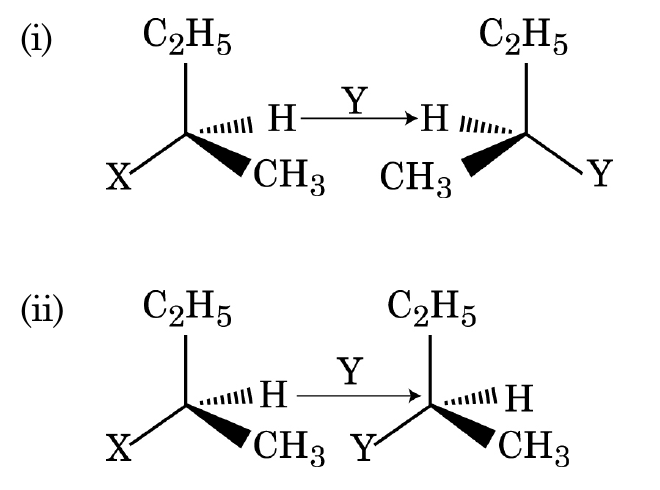
Which of the following two reactions is and why ?
2 marks: very short answer
Why are haloarenes less reactive towards nucleophilic substitution reaction? Give two reasons.
Solution
Any two:
1. Resonance: the lone pair on the halogen is delocalised into the ring, giving the C–X bond partial double-bond character, so it is harder to break.
2. Hybridisation: the C of C–X is (more s-character, more electronegative), so the bond is shorter and stronger.
3. Instability of the phenyl cation (no resonance stabilisation), so does not occur.
4. Repulsion between the electron-rich ring and the approaching nucleophile.
(a) Draw the structure of the given compound : 4–Bromo–3–methylpent–2–ene
(b) What happens when chloroethane is treated with aqueous potassium hydroxide ?
Solution
(a) Pent-2-ene chain with a methyl group on C-3 and Br on C-4:
(C-1 , C-2 =CH, C-3 =C(), C-4 CHBr, C-5 )
(b) Aqueous KOH supplies , which replaces Cl by nucleophilic substitution; ethanol is formed:
(a) In the following pair of halogen compounds, which compound undergoes reaction faster and why ? 2-chloro-2-methylpropane and 3-chloropentane
(b) Arrange the following compounds in increasing order of their reactivity towards displacement : 2–Bromo–2–methylbutane, 1–Bromopentane, 2–Bromopentane.
Solution
(a) (tertiary) reacts faster. goes through a carbocation; the tertiary carbocation is more stable (+I effect and hyperconjugation of three methyl groups) than the secondary carbocation from 3-chloropentane.
(b) is slowed by crowding at the reacting carbon (tertiary < secondary < primary):
2-Bromo-2-methylbutane < 2-Bromopentane < 1-Bromopentane
Draw the structures of major monohalo products in each of the following reactions : (i) (ii) Cyclohexene +
Solution
(i) Markovnikov addition; adds to the terminal carbon to form the resonance-stabilised benzylic carbocation:
(1-bromo-1-phenylethane)
(ii) In UV light, free-radical substitution occurs at the allylic position: 3-bromocyclohexene (Br on the carbon next to the C=C) + HBr.
Give reasons for the following : (i) Grignard reagent should be prepared under anhydrous conditions. (ii) Alkyl halides give alcohol with aqueous KOH whereas in the presence of alcoholic KOH, alkenes are formed.
(a) In the following pair of compounds, which compound undergoes reaction faster and why ? 1-iodobutane or 1-bromobutane
(b) Write the major product in the following : Ethylbenzene
(a) (b) Identify 'A' and 'B' in the above reactions.
3 marks: short answer
Compound 'X' with molecular formula reacts with aqueous KOH to give an alcohol. The rate of this reaction depends only on the concentration of the compound 'X'. When an optically active isomer 'Y' of the compound 'X' was treated with aqueous KOH solution, the rate of reaction was found to be dependent on concentration of compound 'Y' and aqueous KOH both. (a) Write down the structural formula of both 'X' and 'Y'. (b) Out of 'X' and 'Y', which one will undergo racemisation and why? (c) Out of 'X' and 'Y', which one will form product with inversion of configuration and why?
Solution
(a) X reacts by (rate depends only on [X]): a tertiary halide, 2-bromo-2-methylpropane, .
Y is optically active and reacts by : 2-bromobutane, (chiral).
(b) Racemisation occurs in an reaction: the planar carbocation is attacked equally from both sides. Note that X has no chiral centre, so for an optically active substrate this applies to an path; between X and Y, the substrate X is the one reacting through a carbocation (racemisation is the characteristic outcome of this path).
(c) Y gives inversion of configuration: in the nucleophile attacks from the side opposite to the leaving group (backside attack), giving Walden inversion.
(a) Write the major product in the following reaction : Cyclohexene + (heat) → ?
(b) Define Racemic mixture.
(c) p-dichlorobenzene has a higher melting point as compared to its ortho and meta isomers. Why ?
Solution
(a) At high temperature bromine substitutes at the allylic position (free-radical substitution), so the product is 3-bromocyclohexene (Br on the carbon next to the C=C).
(b) A racemic mixture is an equimolar mixture of the d- and l-enantiomers; it has zero optical rotation because the rotation of one is cancelled by the other.
(c) The para isomer is symmetrical, so its molecules fit closely into the crystal lattice. Stronger intermolecular forces in the crystal need more energy to break, so its melting point is higher than that of the o- and m-isomers.
Draw the structure of the major monohalo product for each of the following reaction : (a) 1-chloro-4-ethylbenzene ? (b) 1-methylcyclohexene + HBr → ? (c) 4-(hydroxymethyl)phenol, ?
Solution
(a) At high temperature, bromination occurs at the benzylic carbon (free-radical substitution; the benzylic radical is resonance-stabilised): product 1-bromo-1-(4-chlorophenyl)ethane, (p).
(b) Markovnikov addition: adds to the ring CH carbon, giving the tertiary carbocation on the carbon bearing ; product 1-bromo-1-methylcyclohexane (Br and on the same ring carbon).
(c) Only the alcoholic (benzylic) –OH is replaced; the phenolic –OH is not, because its C–O bond has partial double-bond character: product 4-(chloromethyl)phenol, (p).
How do you convert : (a) Chlorobenzene to biphenyl (b) Propene to 1-Iodopropane (c) 2-bromobutane to but-2-ene.
Solution
(a) Fittig reaction:
(b) Anti-Markovnikov addition of HBr (peroxide effect), then Finkelstein reaction:
(c) Dehydrohalogenation with alcoholic KOH (Saytzeff rule, more substituted alkene is major):
(a) Define the following : (i) Enantiomers (ii) Racemic mixture
(b) Why is chlorobenzene resistant to nucleophilic substitution reaction ?
Solution
(a) (i) Enantiomers are stereoisomers that are non-superimposable mirror images of each other.
(ii) A racemic mixture is an equimolar mixture of the dextro and laevo enantiomers; it is optically inactive (zero rotation).
(b) (i) Resonance: a lone pair of Cl is delocalised into the ring, so the C–Cl bond gets partial double-bond character and is hard to break. (ii) The carbon bearing Cl is hybridised (more s character, shorter stronger bond). (iii) The phenyl cation is unstable, so is not possible, and the electron-rich ring repels the nucleophile.
(a) Which of the following is an allylic halide ? (i) (ii)
(b) Out of chlorobenzene and 2,4,6-trinitrochlorobenzene, which is more reactive towards nucleophilic substitution and why ?
(c) Which isomer of has the lowest boiling point ?
Solution
(a) (ii) : Br is on the carbon next to the C=C (allylic). In (i) Br is on a doubly bonded carbon (vinylic).
(b) 2,4,6-Trinitrochlorobenzene. The three – groups at o- and p-positions withdraw electrons (–I, –R), making the ring carbon attached to Cl electron-deficient and stabilising the carbanion intermediate by resonance; so the nucleophile attacks easily (it is hydrolysed even by warm water).
(c) (2-chloro-2-methylpropane, tert-butyl chloride): it is the most branched and most compact, so it has the smallest surface area and weakest van der Waals forces.
Give reasons for the following : (a) Chlorine is ortho/para directing in electrophilic aromatic substitution reactions, though chlorine is an electron withdrawing group. (b) Racemic mixture is optically inactive. (c) Allyl chloride is hydrolysed more readily than n-propyl chloride.
Solution
(a) Cl withdraws electrons by –I effect (so it deactivates the ring), but by +R effect it releases electrons to the ring. Resonance increases the electron density at o- and p-positions and stabilises the carbocation intermediate formed by attack at these positions, so substitution occurs at o/p-positions.
(b) It contains equal amounts of the two enantiomers; the rotation by one is exactly cancelled by the other (external compensation), so net rotation is zero.
(c) Allyl chloride ionises to the allyl carbocation, , which is resonance-stabilised. n-Propyl chloride would give an unstable primary carbocation. So allyl chloride is hydrolysed faster.
Write main product formed when : (a) Methyl chloride is treated with NaI/Acetone. (b) 2,4,6-trinitrochlorobenzene is subjected to hydrolysis. (c) n-Butyl chloride is treated with alcoholic KOH.
Solution
(a) Finkelstein reaction: : iodomethane (NaCl precipitates in acetone, driving the reaction).
(b) The three – groups activate the ring so strongly that warm water replaces Cl: 2,4,6-trinitrophenol (picric acid).
(c) Dehydrohalogenation: : but-1-ene.
Answer any 3 of the following : (a) Which isomer of gives a single monochloro compound in bright sunlight ? (b) Arrange the following compounds in increasing order of reactivity towards reaction : 2-Bromopentane, 1-Bromopentane, 2-Bromo-2-methylbutane (c) Why p-dichlorobenzene has higher melting point than those of ortho- and meta-isomers ? (d) Identify A and B in the following : Bromocyclobutane
Justify and arrange the following compounds of each set in increasing order of reactivity towards the asked displacement : (a) 1-Bromobutane, 2-Bromobutane, 2-Bromo-2-Methylpropane ( reaction) (b) 1-Bromobutane, 2-Bromobutane, 2-Bromo-2-Methylpropane ( reaction)
(i) Out of and , which one is more reactive towards and why ? (ii) Write the product formed when p-nitrochlorobenzene is heated with aqueous NaOH at 443 K followed by acidification. (iii) Why dextro and laevo-rotatory isomers of Butan-2-ol are difficult to separate by fractional distillation ?
Among all the isomers of molecular formula , identify (a) the one isomer which is optically active. (b) the one isomer which is highly reactive towards . (c) the two isomers which give same product on dehydrohalogenation with alcoholic KOH.
(a) Identify the chiral molecule in the following pair : (i) 3-methylbutan-2-ol, and (ii) 2,4-dimethylpentan-3-ol, (b) Write the structure of the product when chlorobenzene is treated with methyl chloride in the presence of sodium metal and dry ether. (c) Write the structure of the alkene formed by dehydrohalogenation of 1-bromo-1-methylcyclohexane with alcoholic KOH.
The following compounds are given to you : 2-Bromopentane, 2-Bromo-2-methylbutane, 1-Bromopentane (a) Write the compound which is most reactive towards reaction. (b) Write the compound which is optically active. (c) Write the compound which is most reactive towards β-elimination reaction.
Write the major monohalo product(s) in each of the following reactions : (i) Cyclohexene + ? (ii) ? (iii) 4-(Hydroxymethyl)phenol (p) + HCl ?
Get every solution for all chapters
- Every board question of every chapter, each fully solved the way the board gives marks
- 19 complete board papers, each followed by its solutions
- Weightage and most-asked topics for every chapter
- Instant PDF download, colour and black & white print copies
Revising the chapter first? Complete Chemistry Notes for Class 12 (NCERT 2026-27, CBSE Board 2027) →
What you get in the pack
- Questions from 138 CBSE papers, 2016 to 2026: every set code available
- Complete: 2111 different questions and parts from all set codes, 10 chapters and 19 full papers
- Part A: all 10 chapters, questions sorted chapter-wise and by marks
- Year-wise weightage table and most-asked topics for every chapter
- Part B: 19 full board papers, each followed by its complete solutions
- Every reaction, mechanism and numerical worked with balanced equations
- Questions on topics out of the board syllabus flagged
All chapters in this pack
- PYQ Ch 1 Solutions
- PYQ Ch 2 Electrochemistry
- PYQ Ch 3 Chemical Kinetics
- PYQ Ch 4 The d- and f-Block Elements
- PYQ Ch 5 Coordination Compounds
- PYQ Ch 6 Haloalkanes and Haloarenes
- PYQ Ch 7 Alcohols, Phenols and Ethers
- PYQ Ch 8 Aldehydes, Ketones and Carboxylic Acids
- PYQ Ch 9 Amines
- PYQ Ch 10 Biomolecules
- Board Paper 2026 Set 56-1-1 with Solutions
- Board Paper 2026 Set 56-1-2 with Solutions
- Board Paper 2026 Set 56-1-3 with Solutions
- Board Paper 2026 Set 56-2-1 with Solutions
- Board Paper 2025 Set 56-1-1 with Solutions
- Board Paper 2025 Set 56-2-1 with Solutions
- Board Paper 2024 Set 56-1-1 with Solutions
- Board Paper 2024 Set 56-2-1 with Solutions
- Board Paper 2023 Set 56-1-1 with Solutions
- Board Paper 2023 Set 56-2-1 with Solutions
- Board Paper 2022 Term 2 Set 56-1-1 with Solutions
- Board Paper 2022 Term 2 Set 56-2-1 with Solutions
- Board Paper 2020 Set 56-1-1 with Solutions
- Board Paper 2020 Set 56-2-1 with Solutions
- Board Paper 2019 Set 56-1-1 with Solutions
- Board Paper 2019 Set 56-2-1 with Solutions
- Board Paper 2018 Set 56-1 with Solutions
- Board Paper 2017 Set 56-1 with Solutions
- Board Paper 2016 Set 56-1 with Solutions