
Chemical Kinetics: Class 12 PYQs 2016–2026 with solutions
All 55 CBSE board questions asked from Chemical Kinetics in 17 board papers, with the year, set and marks of each. 30 are solved free below. The Class 12 Chemistry PYQ Book: Solved Board Papers 2016-2026 (CBSE) has every solution, all chapters and 19 full board papers.
Subject expert: Dr. S.L. Verma, B.Sc. (Hons), M.Sc. Chemistry, PhD · 23+ years teaching


Free: NCERT solutions for Class 12 Chemistry →
Chemical Kinetics: board weightage
Board weightage 2016–2026
| Year | 2016 | 2017 | 2018 | 2019 | 2020 | 2022 | 2023 | 2024 | 2025 | 2026 |
|---|---|---|---|---|---|---|---|---|---|---|
| Questions | 2 | 2 | 2 | 4 | 8 | 4 | 8 | 8 | 8 | 10 |
| Marks | 5 | 4 | 5 | 10 | 20 | 10 | 14 | 14 | 16 | 16 |
Most asked topics
56 questions from 17 papers. Repeated questions are shown once with every year they were asked.
Jump to: 1 mark2 marks3 marks4 marks5 marks
1 mark: MCQ and Assertion–Reason
Which of the following curve represents the first order reaction?
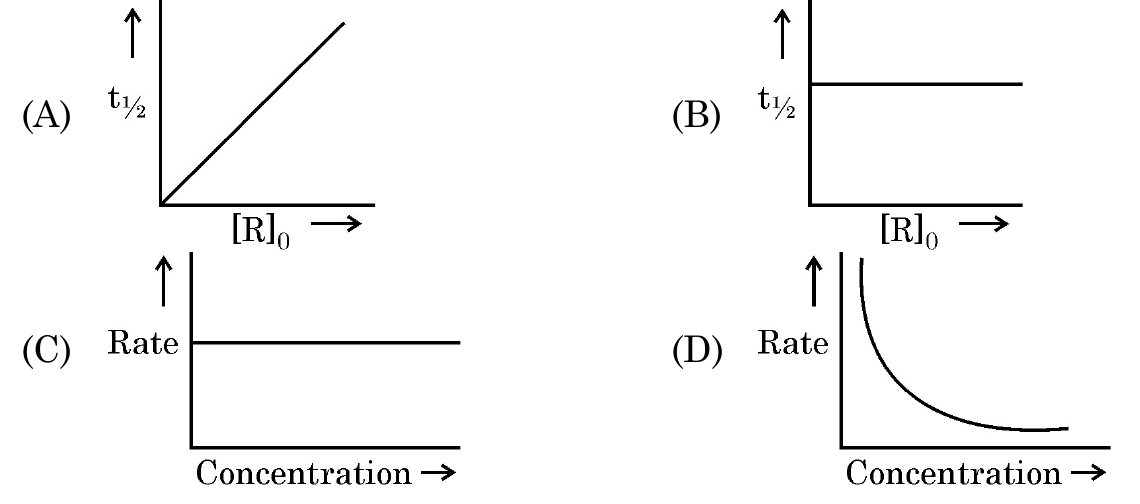
Solution
Answer: (B)
For a first-order reaction , which does not depend on the initial concentration : a horizontal line. (Graph A is zero order, ; a horizontal rate–concentration line, C, is also zero order.)
Which of the following represents the fraction of molecules with energies equal to or greater than ?
Solution
Answer: (B)
In the Arrhenius equation , the factor is the fraction of molecules having kinetic energy equal to or greater than .
Identify the correct statement :
Solution
Answer: (B)
Molecularity is defined only for an elementary step (it is a theoretical whole number, 1, 2 or rarely 3). A complex reaction goes through several steps, so molecularity has no meaning for the overall reaction; its kinetics is decided by the slowest step.
The order for the given reaction is :
, Rate =
Solution
Answer: (A) 1.5
Order = sum of the powers in the experimental rate law = (the stoichiometric coefficients do not decide it).
Assertion (A) : The molecularity of the given reaction is 2 :
Reason (R) : Two molecules of the reactants are involved in simultaneous collision between them.
Solution
Answer: (A)
The decomposition of HI is an elementary bimolecular reaction: two HI molecules must collide at the same time, so its molecularity is 2. Both statements are true and R explains A.
Which among the following is a false statement ?
Solution
Answer: (C)
Molecularity is the number of species colliding in an elementary step, so it is always a whole number (1, 2 or 3), never zero. (B) is true: for zero order.
The number of molecules that react with each other in an elementary reaction is a measure of the :
Solution
Answer: (C) molecularity of the reaction
Molecularity is the number of reacting species (atoms, ions or molecules) that must collide simultaneously in an elementary reaction.
Assertion (A) : In a first order reaction, if the concentration of the reactant is doubled, its half-life is also doubled.
Reason (R) : The half-life of a reaction does not depend upon the initial concentration of the reactant in a first order reaction.
Solution
Answer: (D)
For first order , independent of ; doubling the concentration leaves the half-life unchanged. So A is false and R is true.
For the reaction X + 2Y → P, the differential form equation of the rate law is :
Solution
Answer: (A)
Rate . Multiplying the last equality by 2: .
In the Arrhenius equation, when log k is plotted against 1/T, a straight line is obtained whose :
Solution
Answer: (D)
, which is y = c + mx with slope and intercept log A.
The addition of catalyst during a chemical reaction alters which of the following quantities of the reaction ?
For the elementary reaction P → Q, the rate of disappearance of 'P' increases by a factor of 8 upon doubling the concentration of 'P'. The order of the reaction with respect to 'P' is :
Which of the following is affected by catalyst ?
The order of the reaction is :
Assertion (A) : The molecularity of the reaction appears to be 2.
Reason (R) : Two molecules of the reactants are involved in the given elementary reaction.
The slope in the plot of ln[R] vs. time for a first order reaction is
For the reaction 3A → 2B, rate of reaction is equal to
Will the rate constant of the reaction depend upon T if the (activation energy) of the reaction is zero ?
Calculate the overall order of the reaction whose rate law expression was predicted as : Rate = .
What is the effect of adding a catalyst on (a) Activation energy (), and (b) Gibbs energy (ΔG) of a reaction ?
2 marks: very short answer
Following reaction takes place in one step: . How will the rate of above reaction change if the volume of the reaction vessel is decreased to one third of its original volume? Will there be any change in the order of reaction with the reduced volume?
Solution
For an elementary (one-step) reaction, rate .
Reducing the volume to one-third triples every concentration:
The rate becomes 27 times. The order does not change (it stays 3); it depends on the rate law, not on the volume.
The concentration of the reactant is reduced from 0.6 mol L to 0.2 mol L in 5 minutes in a first order reaction. Calculate rate constant of the reaction. (log 3 = 0.48)
Solution
For a first-order reaction,
0.22 min
Rate constant k for the first order reaction is s. Calculate the time required for three-fourth of the reactant to decompose. (log 4 = 0.60)
Solution
When three-fourth has decomposed, , so .
s (≈ 544 s)
(a) Define activation energy. (b) Write the unit of rate constant for (i) zero order reaction, (ii) second order reaction.
Solution
(a) Activation energy is the minimum extra energy that the reacting molecules must absorb to form the activated complex (to cross the energy barrier) and change into products. = energy of activated complex – average energy of reactants.
(b) Unit of k = (mol L) s.
(i) Zero order (n = 0): mol L s
(ii) Second order (n = 2): L mol s (mol L s)
The rate constant for a zero order reaction A → P is 0.0030 mol Ls. How long will it take for the initial concentration of A to fall from 0.10 M to 0.075 M ?
Solution
For a zero-order reaction, , so
8.33 s
The decomposition of on platinum surface is zero order reaction. What are the rates of production of and if k = mol L s ?
Solution
Rate . For zero order, rate = k.
Rate of production of = k = mol L s
Rate of production of = 3k = mol L s
Define the following terms : (a) Pseudo first order reaction (b) Half-life period of reaction ()
Solution
(a) A pseudo first order reaction is one whose molecularity/apparent order is higher but which behaves as first order because one reactant is in large excess, so its concentration hardly changes. Example: acid hydrolysis of ethyl acetate, ; rate = k′[ester].
(b) Half-life is the time in which the concentration of a reactant is reduced to one half of its initial concentration.
Define molecularity of the reaction. State any one condition in which a bimolecular reaction may be kinetically of first order.
Solution
Molecularity: the number of reacting species (atoms, ions or molecules) taking part in an elementary reaction, which must collide simultaneously to bring about the reaction.
A bimolecular reaction becomes kinetically first order when one of the reactants is present in large excess (e.g. water in the hydrolysis of an ester), so its concentration stays practically constant; it is a pseudo first order reaction.
A first order reaction has a rate constant s. How long will 5 g of this reactant take to reduce to 2.5 g ? [log 2 = 0.301, log 3 = 0.4771, log 4 = 0.6021]
Solution
5 g → 2.5 g is one half-life.
554.6 s (≈ s)
(a) The conversion of molecule A to B followed second order kinetics. If concentration of A increased to three times, how will it affect the rate of formation of B ? (b) Define Pseudo first order reaction with an example.
Define rate of reaction. Write two factors that affect the rate of reaction.
In the given reaction the rate of formation of is mol L s. Calculate the (i) rate of reaction, and (ii) rate of disappearance of .
Analyse the given graph, drawn between concentration of reactant vs. time.
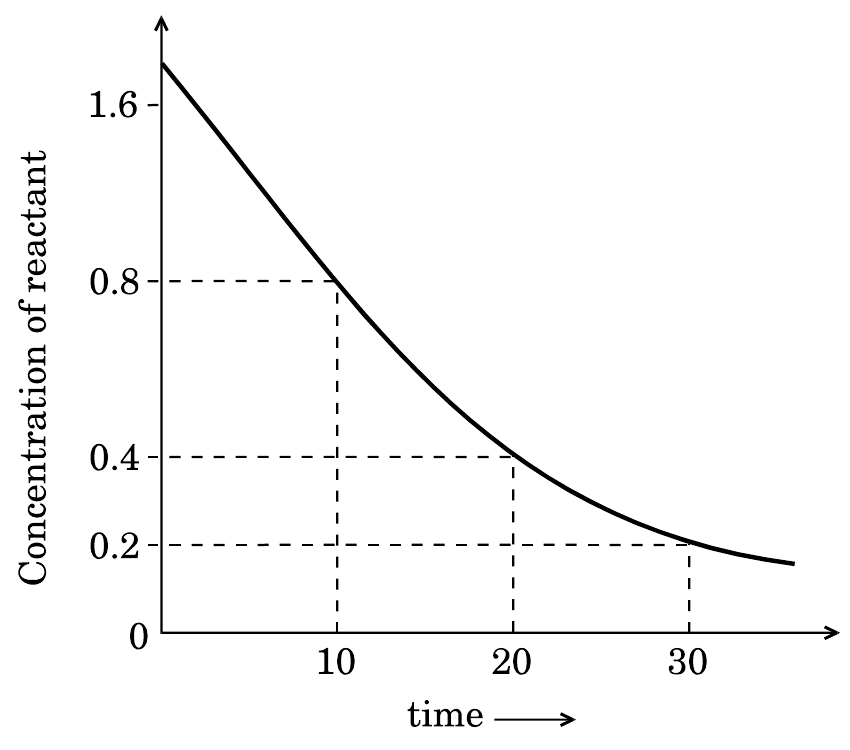
(a) Predict the order of reaction. (b) Theoretically, can the concentration of the reactant reduce to zero after infinite time ? Explain.
A reaction is first order w.r.t. reactant A as well as w.r.t. reactant B. Give the rate law. Also give one point of difference between average rate and instantaneous rate.
For a reaction the proposed mechanism is as given below : (1) (slow) (2) (fast) (i) Write rate law for the reaction. (ii) Write the overall order of reaction. (iii) Out of steps (1) and (2), which one is rate determining step ?
Define order of reaction. Predict the order of reaction in the given graphs : (a) vs is a horizontal line (t½ constant); (b) vs is a straight line through the origin; where is the initial concentration of reactant and is half-life.
For the reaction , the rate of formation of (g) is M s. Calculate the rate of disappearance of (g).
For a reaction : , Rate = k (i) Write the order and molecularity of this reaction. (ii) Write the unit of k.
3 marks: short answer
For the first order thermal decomposition reaction, following data was obtained: . At t = 0 s, total pressure = 0.30 atm; at t = 30 s, total pressure = 0.50 atm. Calculate rate constant. [Given: log 3 = 0.48]
Solution
Let x atm of decompose: , so atm.
Pressure of reactant at 30 s: atm.
A certain reaction is 50% complete in 20 minutes at 300 K and the same reaction is 50% complete in 5 minutes at 350 K. Calculate the activation energy if it is a first order reaction. [R = 8.314 J K mol; log 4 = 0.602]
Solution
For first order, :
min (300 K); min (350 K);
J mol ≈ 24.2 kJ mol
The following initial rate data were obtained for the reaction :
| Expt. No. | [NO]/mol L | []/mol L | Initial Rate (mol L s) |
|---|---|---|---|
| 1 | 0.05 | 0.05 | |
| 2 | 0.05 | 0.15 | |
| 3 | 0.15 | 0.05 |
(a) What is the order with respect to NO and in the reaction ? (b) Calculate the rate constant (k). (c) Determine the rate of reaction when concentration of NO and are 0.4 M and 0.2 M, respectively.
Solution
Let rate = .
(a) Expt 2 ÷ Expt 1 ([NO] same): , , so q = 1 (first order in ).
Expt 3 ÷ Expt 1 ([] same): , , so p = 2 (second order in NO).
(b) From Expt 1:
8 L mol s
(c) Rate 0.256 mol L s ()
The rate of a gaseous reaction triples when temperature is increased from 17°C to 27°C. Calculate the energy of activation for this reaction. [Given : 2.303 R = 19.15 JK mol, log 3 = 0.48]
Solution
K, K,
J mol ≈ 79.97 kJ mol
A first order reaction is 50% complete in 30 minutes at 300 K and in 10 minutes at 320 K. Calculate activation energy () for the reaction. [R = 8.314 J K mol] [Given : log 2 = 0.3010, log 3 = 0.4771, log 4 = 0.6021]
Solution
For first order , so .
J mol ≈ 43.85 kJ mol
A first order reaction is 50% complete in 40 minutes. Calculate the time required for the completion of 90% of reaction. [Given : log 2 = 0.3010, log 10 = 1]
Solution
min
For 90% completion,
132.9 min
(Equivalently, min.)
A first order reaction takes 30 minutes for 75% decomposition. Calculate . Given : [log 2 = 0.3, log 3 = 0.48, log 4 = 0.6, log 5 = 0.7]
Solution
After 75% decomposition, .
min
15 min
(Check: 75% decomposition = two half-lives, 100% → 50% → 25%, so min.)
How will the rate of the reaction be affected when (a) Surface area of the reactant is reduced, (b) Catalyst is added in a reversible reaction, and (c) Temperature of the reaction is increased ?
The decomposition of on platinum surface is zero order reaction. If rate constant (k) is M s, how long will it take to reduce the initial concentration of from 0.1 M to 0.064 M.
The following data were obtained for the reaction : A + 2B → C
| Experiment | [A]/M | [B]/M | Initial rate of formation of C /M min |
|---|---|---|---|
| 1 | 0.2 | 0.3 | |
| 2 | 0.1 | 0.1 | |
| 3 | 0.4 | 0.3 | |
| 4 | 0.1 | 0.4 |
(a) Find the order of reaction with respect to A and B. (b) Write the rate law and overall order of reaction. (c) Calculate the rate constant (k).
A first order reaction is 50% completed in 40 minutes at 300 K and in 20 minutes at 320 K. Calculate the activation energy of the reaction. (Given : log 2 = 0.3010, log 4 = 0.6021, R = 8.314 JK mol)
A first order reaction takes 20 minutes for 25% decomposition. Calculate the time when 75% of the reaction will be completed. (Given : log 2 = 0.3010, log 3 = 0.4771, log 4 = 0.6021)
The rate constant for the first order decomposition of is given by the following equation : . Calculate for this reaction and rate constant k if its half-life period be 200 minutes. (Given : R = 8.314 JK mol)
4 marks: case-based / source-based
The rate of a chemical reaction is expressed either in terms of decrease in the concentration of reactants or increase in the concentration of a product per unit time. Rate of the reaction depends upon the nature of reactants, concentration of reactants, temperature, presence of catalyst, surface area of the reactants and presence of light. Rate of reaction is directly related to the concentration of reactant. Rate law states that the rate of reaction depends upon the concentration terms on which the rate of reaction actually depends, as observed experimentally. The sum of powers of the concentration of the reactants in the Rate law expression is called order of reaction while the number of reacting species taking part in an elementary reaction which must collide simultaneously in order to bring about a chemical reaction is called molecularity of the reaction.
(a) (i) What is a rate determining step ? (ii) Define complex reaction. (2)
(b) What is the effect of temperature on the rate constant of a reaction ? (1)
OR
(b) Why is molecularity applicable only for elementary reactions whereas order is applicable for elementary as well as complex reactions ? (1)
(c) The conversion of molecule X to Y follows second order kinetics. If concentration of X is increased 3 times, how will it affect the rate of formation of Y ? (1)
Solution
(a) (i) The slowest step in the mechanism of a complex reaction; it controls the overall rate.
(ii) A complex reaction takes place in a series of two or more elementary steps.
(b) The rate constant increases with temperature; for most reactions it nearly doubles for a 10 K rise (: a larger fraction of molecules has energy ≥ ).
OR (b) Molecularity is the number of species colliding in a single step, so it is defined only for an elementary step; in a complex reaction each step may have a different molecularity, so it has no meaning for the overall reaction. Order is found experimentally (set by the slowest step), so it applies to both.
(c) Rate = . New rate = : the rate becomes 9 times.
The rate of reaction is concerned with decrease in concentration of reactants or increase in the concentration of products per unit time. It can be expressed as instantaneous rate at a particular instant of time and average rate over a large interval of time. Mathematical representation of rate of reaction is given by rate law. Rate constant and order of a reaction can be determined from rate law or its integrated rate equation.
(i) What is average rate of reaction ? (1)
(ii) Write two factors that affect the rate of reaction. (1)
(iii) (1) What happens to rate of reaction for zero order reaction ? (2) What is the unit of k for zero order reaction ? (2)
OR
(iii) (1) For a reaction P + 2Q → Products, Rate = . What is the order of the reaction ? (2) Define pseudo first order reaction with an example. (2)
Solution
(i) The change in concentration of a reactant or product divided by the time interval over which it occurs: .
(ii) Any two: concentration of reactants, temperature, presence of a catalyst, surface area, nature of reactants, light.
(iii) (1) For a zero-order reaction the rate is independent of the concentration of the reactant: rate = k (constant) throughout.
(2) mol L s.
OR (iii) (1) Order 1.5
(2) A reaction that appears to be of higher order but follows first-order kinetics because one reactant is present in large excess. Example: acid hydrolysis of ethyl acetate, ; rate = k[].
5 marks: long answer
(a) Visha plotted a graph between concentration of R and time for a reaction R → P. On the basis of this graph, answer the following questions :
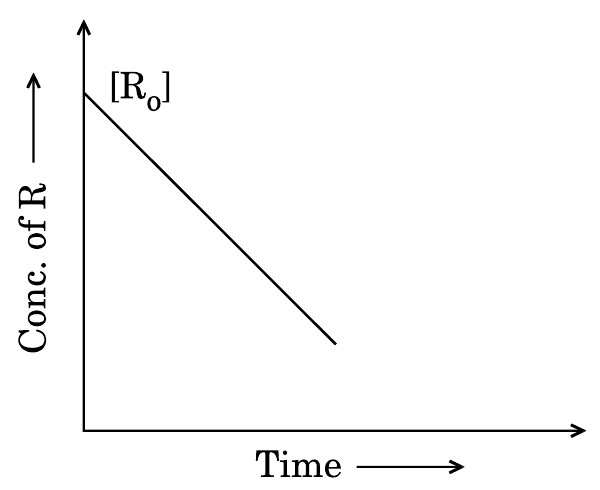
(i) Predict the order of reaction. (ii) What does the slope of the line indicate ? (iii) What are the units of rate constant ?
(b) A first order reaction takes 25 minutes for 25% decomposition. Calculate . [Given : log 2 = 0.3010, log 3 = 0.4771, log 4 = 0.6021]
Solution
(a) (i) [R] falls linearly with time (): zero order.
(ii) The slope of the line is –k (the negative of the rate constant).
(iii) mol L s.
(b) After 25% decomposition, , so .
min
60.2 min
(a) The rate constant for a first order reaction is 60 s. How much time will it take to reduce the initial concentration of the reactant to its th value ? (b) Write two factors that affect the rate of a chemical reaction. (c) Write two conditions for the collisions to be effective collisions.
Solution
(a)
s
(Or: 1/16 = , four half-lives; s; s.)
(b) Any two: concentration of reactants, temperature, catalyst, surface area, nature of reactants.
(c) (i) The colliding molecules must have energy equal to or greater than the threshold energy. (ii) They must collide with proper orientation.
Get every solution for all chapters
- Every board question of every chapter, each fully solved the way the board gives marks
- 19 complete board papers, each followed by its solutions
- Weightage and most-asked topics for every chapter
- Instant PDF download, colour and black & white print copies
Revising the chapter first? Complete Chemistry Notes for Class 12 (NCERT 2026-27, CBSE Board 2027) →
What you get in the pack
- Questions from 138 CBSE papers, 2016 to 2026: every set code available
- Complete: 2111 different questions and parts from all set codes, 10 chapters and 19 full papers
- Part A: all 10 chapters, questions sorted chapter-wise and by marks
- Year-wise weightage table and most-asked topics for every chapter
- Part B: 19 full board papers, each followed by its complete solutions
- Every reaction, mechanism and numerical worked with balanced equations
- Questions on topics out of the board syllabus flagged
All chapters in this pack
- PYQ Ch 1 Solutions
- PYQ Ch 2 Electrochemistry
- PYQ Ch 3 Chemical Kinetics
- PYQ Ch 4 The d- and f-Block Elements
- PYQ Ch 5 Coordination Compounds
- PYQ Ch 6 Haloalkanes and Haloarenes
- PYQ Ch 7 Alcohols, Phenols and Ethers
- PYQ Ch 8 Aldehydes, Ketones and Carboxylic Acids
- PYQ Ch 9 Amines
- PYQ Ch 10 Biomolecules
- Board Paper 2026 Set 56-1-1 with Solutions
- Board Paper 2026 Set 56-1-2 with Solutions
- Board Paper 2026 Set 56-1-3 with Solutions
- Board Paper 2026 Set 56-2-1 with Solutions
- Board Paper 2025 Set 56-1-1 with Solutions
- Board Paper 2025 Set 56-2-1 with Solutions
- Board Paper 2024 Set 56-1-1 with Solutions
- Board Paper 2024 Set 56-2-1 with Solutions
- Board Paper 2023 Set 56-1-1 with Solutions
- Board Paper 2023 Set 56-2-1 with Solutions
- Board Paper 2022 Term 2 Set 56-1-1 with Solutions
- Board Paper 2022 Term 2 Set 56-2-1 with Solutions
- Board Paper 2020 Set 56-1-1 with Solutions
- Board Paper 2020 Set 56-2-1 with Solutions
- Board Paper 2019 Set 56-1-1 with Solutions
- Board Paper 2019 Set 56-2-1 with Solutions
- Board Paper 2018 Set 56-1 with Solutions
- Board Paper 2017 Set 56-1 with Solutions
- Board Paper 2016 Set 56-1 with Solutions