
Electrochemistry: Class 12 PYQs 2016–2026 with solutions
All 56 CBSE board questions asked from Electrochemistry in 17 board papers, with the year, set and marks of each. 30 are solved free below. The Class 12 Chemistry PYQ Book: Solved Board Papers 2016-2026 (CBSE) has every solution, all chapters and 19 full board papers.
Subject expert: Dr. S.L. Verma, B.Sc. (Hons), M.Sc. Chemistry, PhD · 23+ years teaching


Free: NCERT solutions for Class 12 Chemistry →
Electrochemistry: board weightage
Board weightage 2016–2026
| Year | 2016 | 2017 | 2018 | 2019 | 2020 | 2022 | 2023 | 2024 | 2025 | 2026 |
|---|---|---|---|---|---|---|---|---|---|---|
| Questions | 2 | 2 | 2 | 4 | 6 | 4 | 11 | 7 | 9 | 9 |
| Marks | 10 | 5 | 10 | 20 | 17 | 10 | 27 | 23 | 29 | 31 |
Most asked topics
56 questions from 17 papers. Repeated questions are shown once with every year they were asked.
Jump to: 1 mark2 marks3 marks4 marks5 marks
1 mark: MCQ and Assertion–Reason
What will happen during the electrolysis of aqueous solution of by using platinum electrodes?
Solution
Answer: (D) gas will be released at anode
Cathode: (copper deposits). Anode: ; although oxidation of water has a lower , chloride is oxidised because of the overpotential for oxygen.
Consider the following reaction :
Given : V, V, 1 F = 96500 C mol
for the above reaction is :
Solution
Answer: (A) –301.080 kJ mol
V; n = 2 (Zn → ).
J mol = –301.080 kJ mol.
Standard electrode potential for couple is +0.15 V and that for the couple is –0.74 V. The two couples in their standard states are connected to make a cell. The cell potential will be
Solution
Answer: (B) +0.89 V
The couple with higher () is the cathode; Cr is the anode.
V
The charge required for the reduction of 1 mol of to is
Solution
Answer: (B) 3 F
Mn changes from +7 in to +4 in : . 3 mol of electrons = 3 F per mole of .
Assertion (A) : Cu cannot liberate on reaction with dilute mineral acids.
Reason (R) : Cu has positive electrode potential.
Solution
Answer: (A)
V, higher than that of hydrogen (0.00 V). So Cu cannot reduce to ; R explains A.
During electrolysis of aqueous solution of NaCl :
Solution
Answer: (A)
At the cathode water ( = –0.83 V) is reduced in preference to (–2.71 V): . At the anode is evolved (oxygen overpotential).
The correct cell to represent the following reaction is :
ΔG and for a spontaneous reaction will be :
Which of the following solutions of KCl will have the highest value of molar conductivity ?
Assertion (A) : Conductivity decreases with decrease in concentration of electrolyte.
Reason (R) : Number of ions per unit volume that carry the current in a solution decreases on dilution.
Out of zinc and tin, whose coating is better to protect iron objects ?
If the standard electrode potential of an electrode is greater than zero, then we can infer that its
2 marks: very short answer
Calculate the potential of Iron electrode in which the concentration of ion is 0.01 M. ( V at 298 K) [Given : log 10 = 1]
Solution
Electrode reaction: , n = 2
–0.509 V
On diluting two electrolytes 'A' and 'B', the of 'A' increases 25 times while that of 'B' increases by 1.5 times. Which of the two electrolytes is strong ? Justify your answer graphically.
Solution
B is the strong electrolyte. A strong electrolyte is almost fully dissociated at all concentrations, so rises only slightly on dilution (due to reduced interionic attraction), following . A weak electrolyte's degree of dissociation increases greatly on dilution, so its increases steeply (here 25 times).
Graph of against : for B (strong, e.g. KCl) a straight line with a small negative slope, meeting the y-axis at ; for A (weak, e.g. ) a curve that rises very sharply as and cannot be extrapolated.
The electrical resistance of a column of 0.05 mol L NaOH solution of diameter 1 cm and length 50 cm is ohm. Calculate the conductivity.
Solution
Area cm; l = 50 cm
Resistivity Ω cm
Conductivity S cm
Give reasons : (i) Mercury cell delivers a constant potential during its life time. (ii) In the experimental determination of electrolytic conductance, Direct Current (DC) is not used.
Solution
(i) The overall reaction does not involve any ion in solution whose concentration changes during use, so the potential stays constant (≈ 1.35 V).
(ii) DC would cause electrolysis: the composition of the solution would change and products would collect on the electrodes (polarisation). So alternating current is used.
Define fuel cell with an example. What advantages do the fuel cells have over primary and secondary batteries ?
Solution
A fuel cell is a galvanic cell that converts the energy of combustion of fuels such as hydrogen, methane or methanol directly into electrical energy. Example: the fuel cell (used in the Apollo space programme): .
Advantages: high efficiency (about 70%); pollution-free; supplies electricity continuously as long as the reactants are fed (no need for replacement or recharging).
Write the Nernst equation for the following cell reaction : How will the be affected when concentration of (i) ions is increased and (ii) ions is increased ?
(i) State Kohlrausch's law of independent migration of ions. (ii) Calculate the degree of dissociation (α) of if and of are 48 S cm mol and 400 S cm mol respectively.
For an electrochemical cell , give the cell representation. Also write the Nernst equation for the above cell at 25°C.
Write the name of the cell which is generally used in hearing aids. Write the reactions taking place at the anode and the cathode of this cell.
3 marks: short answer
(i) Why is the Equilibrium Constant () related to and not to ? (ii) Two metals 'A' and 'B' have standard electrode potential values of –0.24 V and +0.80 V respectively. Which of these will liberate hydrogen gas from dil. ? (iii) Write the cell reaction which occurs in lead storage battery when it is in charging.
Solution
(i) At equilibrium ; then the Nernst equation gives . So is related to ; (being zero at equilibrium) cannot give it.
(ii) Metal A ( V, below hydrogen) can reduce and liberate .
(iii) Charging:
What type of battery is Mercury cell? Why it is more advantageous than dry cell? Write overall reaction taking place in Mercury cell.
Solution
It is a primary battery. Its cell potential stays constant (about 1.35 V) during its life because the overall reaction involves no ions in solution whose concentration changes; a dry cell's voltage falls with use.
Overall reaction:
Calculate emf of the following cell at 298 K :
Sn | (0.001 M) || (0.01 M) | (1 bar) | Pt(s)
Given : V, V [log 10 = 1]
Solution
Cell reaction: , n = 2
V
Nernst equation:
0.1105 V
(a) State the following : (i) Kohlrausch law of independent migration of ions and (ii) Faraday's first law of electrolysis.
(b) Using values of X and Y given below, predict which is better for coating the surface of iron to prevent corrosion and why ? Given V, V, V
Solution
(a) (i) Kohlrausch's law: the limiting molar conductivity of an electrolyte is the sum of the individual contributions of its cation and anion: .
(ii) Faraday's first law: the amount of chemical reaction (mass of substance deposited or liberated) at any electrode during electrolysis is proportional to the quantity of electricity passed through the electrolyte: .
(b) X is better. X has a more negative (–2.36 V) than iron (–0.44 V), so X is more easily oxidised. It corrodes in preference to iron and protects it even if the coating is scratched (sacrificial protection). Y (–0.14 V) is less reactive than iron; once its coating breaks, iron would corrode.
The electrical resistance of a column of 0.05 M NaOH solution of area 0.8 cm and length 40 cm is ohm. Calculate its resistivity, conductivity and molar conductivity.
Solution
Resistivity 100 Ω cm
Conductivity 0.01 S cm
Molar conductivity 200 S cm mol
When a certain conductivity cell was filled with 0.05 M KCl solution, it has a resistance of 100 ohm at 25ºC. When the same cell was filled with 0.02 M solution, the resistance was 90 ohm. Calculate the conductivity and molar conductivity of solution. (Given : Conductivity of 0.05 M KCl solution = ohmcm)
Solution
Cell constant cm
For : 0.015 S cm
750 S cm mol
Calculate emf of the following cell : Zn (s) | (0.1 M) || (0.001 M) | Sn (s). Given : V, V [log 10 = 1]
(a) The standard Gibbs energy () for the following cell reaction is –300 kJ mol : Calculate for the reaction. (Given: 1F = 96500 C mol)
(b) Calculate for if values for ion and ion are 106 S cmmol and 76.3 S cmmol respectively.
Calculate the emf of the following cell : Zn (s) | (0.01 M) || (0.001 M) | Ag (s). Given : V and V [log 2 = 0.3010, log 3 = 0.4771, log 10 = 1]
Conductivity of M methanoic acid is S cm. Calculate its molar conductivity and degree of dissociation if for methanoic acid is 404 S cm mol.
(a) The cell in which the following reaction occurs : has = 0.236 V at 298 K. Calculate the standard Gibbs energy of the cell reaction. (Given : 1F = 96,500 C mol) (b) How many electrons flow through a metallic wire if a current of 0.5 A is passed for 2 hours ? (Given 1 F = 96,500 C mol)
4 marks: case-based / source-based
Batteries and fuel cells are very useful forms of galvanic cell. Any battery or cell that we use as a source of electrical energy is basically a galvanic cell. However, for a battery to be of practical use it should be reasonably light, compact and its voltage should not vary appreciably during its use. There are mainly two types of batteries – primary batteries and secondary batteries. In the primary batteries, the reaction occurs only once and after use over a period of time the battery becomes dead and cannot be reused again, whereas the secondary batteries are rechargeable. Production of electricity by thermal plants is not a very efficient method and is a major source of pollution. To solve this problem, galvanic cells are designed in such a way that energy of combustion of fuels is directly converted into electrical energy, and these are known as fuel cells. One such fuel cell was used in the Apollo space programme.
(a) How do primary batteries differ from secondary batteries ? (1)
(b) The cell potential of Mercury cell is 1.35 V, and remains constant during its life. Give reason. (1)
(c) Write the reactions involved in the recharging of the lead storage battery. (2)
OR
(c) Write two advantages of fuel cells over other galvanic cells. (2)
Solution
(a) In a primary battery the reaction occurs only once and it cannot be recharged (dry cell, mercury cell); a secondary battery can be recharged by passing current through it in the opposite direction and reused (lead storage battery).
(b) The overall reaction does not involve any ion in solution whose concentration changes during its life, so the potential stays constant.
(c) On recharging, the discharge reaction is reversed:
At the electrode that becomes cathode:
At the electrode that becomes anode:
Overall:
OR (c) (i) Higher efficiency (about 70%) than thermal plants (about 40%). (ii) Pollution-free (product is water) and gives continuous power as long as fuel is supplied.
5 marks: long answer
Calculate emf and ΔG for the following cell at 298 K: . Given: V, V [1 F = 96500 C mol⁻¹, log 10 = 1]
Solution
Cell reaction: , n = 2.
V.
For the reaction: . Calculate emf of the cell at 25 °C. Given: ΔG° = –43500 J mol⁻¹ [log 10 = 1, 1 F = 96500 C mol⁻¹]
Solution
n = 2. V.
, so :
(a) The conductivity of 0.1 mol L solution of NaCl is S cm. Calculate its molar conductivity and degree of dissociation. S cm mol, S cm mol
(b) (i) Following cell reaction occurs in a galvanic cell : , V. Predict the direction of flow of current.
(ii) Differentiate between a primary battery and a secondary battery.
Solution
(a) 106 S cm mol
S cm mol
0.837 (83.7%)
(b) (i) Zn is oxidised (anode, negative) and is reduced (cathode, positive). Electrons flow from Zn to Ag in the external circuit, so the current flows from the silver electrode to the zinc electrode in the external circuit.
(ii) Primary battery: the reaction occurs only once; after use it cannot be recharged (e.g. dry cell, mercury cell). Secondary battery: can be recharged by passing current in the opposite direction and used again (e.g. lead storage battery, Ni–Cd cell).
(a) Resistance of a conductivity cell filled with 0.1 M KCl solution is 100 Ω. If the resistance of the same cell when filled with 0.01 mol L KCl solution is 300 Ω, calculate the conductivity and molar conductivity of 0.01 mol L KCl solution. The conductivity of 0.1 M KCl solution is S cm.
(b) (i) Write any two advantages of fuel cell. (ii) Why does the cell potential of mercury cell remain constant throughout the life ?
Solution
(a) Cell constant cm
For 0.01 M KCl: S cm
430 S cm mol
(b) (i) Any two: high efficiency (about 70%); pollution-free (the only product is water); continuous supply of energy as long as reactants are fed; the water formed can be used (as in spacecraft).
(ii) The overall reaction involves no ion in solution whose concentration changes during use, so the cell potential stays constant (about 1.35 V).
(a) Write the cell reaction and calculate the e.m.f. of the following cell at 298 K : Sn(s) | (0.004 M) || (0.02 M) | (1 Bar) | Pt (s) (Given : V, V)
(b) Account for the following : (i) On the basis of values, gas should be liberated at anode but it is gas which is liberated in the electrolysis of aqueous NaCl. (ii) Conductivity of decreases on dilution.
Solution
(a) Cell reaction: , n = 2
V
0.1105 V
(b) (i) Oxidation of water to needs a much higher voltage than its suggests because of the overpotential of oxygen; so the oxidation of to actually takes place.
(ii) Conductivity is the conductance of a unit volume of solution. On dilution the number of ions per unit volume decreases (even though α increases), so conductivity decreases.
(a) Write the anode and cathode reactions and the overall cell reaction occurring in a lead storage battery during its use.
(b) Calculate the potential for half-cell containing 0.01 M , 0.01 M and M . The half cell reaction is and the standard electrode potential is given as V. [Given : log 10 = 1]
Solution
(a) Anode:
Cathode:
Overall:
(b) n = 6.
0.799 V
(a) Calculate the standard Gibbs energy () of the following reaction at 25 °C : , V, V. Predict whether the reaction will be spontaneous or not at 25 °C. [1 F = 96500 C mol]
(b) Tarnished silver contains . Can this tarnish be removed by placing tarnished silverware in an aluminium pan containing an inert electrolytic solution such as NaCl ? The standard electrode potential for half reaction : is –0.71 V and for is –1.66 V
Solution
(a) In the reaction Au is oxidised (anode) and is reduced (cathode). Balanced: , n = 6.
V
J mol = +2530.23 kJ mol
is positive, so the reaction is not spontaneous.
(b) Yes. Al has the more negative electrode potential, so it acts as the anode and reduces to silver:
V. A positive means : the reaction is feasible and the tarnish is removed.
(a) Define the following : (i) Cell potential (ii) Fuel cell
(b) Calculate emf of the following cell at 25 °C : Zn(s) | (0.1M) || (0.01M) | Cd(s). Given : V, V [log 10 = 1]
Solution
(a) (i) Cell potential: the potential difference between the two electrodes of a galvanic cell (emf when no current is drawn): .
(ii) Fuel cell: a galvanic cell in which the energy of combustion of fuels such as hydrogen or methane is converted directly into electrical energy, e.g. the fuel cell.
(b) Cell reaction: , n = 2
V
0.3305 V
(i) The resistance of 0.05 M solution is found to be 100 ohm. If the cell constant is 0.0354 cm, calculate the molar conductivity of the acetic acid solution.
(ii) State Faraday's first law of electrolysis. How much charge in Faraday is required for the reduction of 1 mol of to ?
Solution
(i) S cm
7.08 S cm mol
(ii) Faraday's first law: the amount of chemical reaction (mass deposited or liberated) at an electrode during electrolysis is proportional to the quantity of electricity passed through the electrolyte; (Z = electrochemical equivalent).
(Mn: +7 → +2), so 5 F are required.
(i) The conductivity of 0.0025 mol L acetic acid is S cm. Calculate its degree of dissociation if for acetic acid is 390 S cm mol.
(ii) Write anode, cathode and overall reaction of lead storage battery.
Solution
(i) S cm mol
0.0538 (about 5.4%)
(ii) Anode:
Cathode:
Overall:
(i) State Kohlrausch's law of independent migration of ions. Write an expression for the limiting molar conductivity of acetic acid according to Kohlrausch's law.
(ii) Calculate the maximum work and log for the given reaction at 298 K : . Given : V, V, 1 F = 96500 C mol
Solution
(i) Kohlrausch's law: the limiting molar conductivity of an electrolyte is the sum of the individual contributions of its anion and cation.
(In practice: .)
(ii) V; n = 2
Maximum work 202650 J mol (202.65 kJ mol)
35.59
(i) State Faraday's first law of electrolysis. How much charge, in terms of Faraday, is required for the reduction of 1 mol to Cu ?
(ii) Calculate emf of the following cell at 298 K for Mg (s) | (0.1 M) || (0.01 M) | Cu (s) [ = + 2.71 V, 1 F = 96500 C mol, log 10 = 1]
Solution
(i) Faraday's first law: the mass of a substance deposited or liberated at an electrode is directly proportional to the quantity of electricity passed through the electrolyte ().
: 2 F are required.
(ii) Cell reaction: , n = 2
2.68 V
(a) Conductivity of M methanoic acid is S cm. Calculate its molar conductivity and degree of dissociation if for methanoic acid is 404 S cmmol.
(b) Calculate the and log for the given reaction at 298 K : . Given : V, V, 1F = 96500 C mol.
(a) Calculate ΔG° for the reaction . Given : for = – 0.76 V and for = + 0.34 V, R = 8.314 JK mol, F = 96500 C mol. (b) Give two advantages of fuel cells.
(a) Out of the following pairs, predict with reason which pair will allow greater conduction of electricity : (i) Silver wire at 30°C or silver wire at 60°C. (ii) 0.1 M solution or 1 M solution. (iii) KCl solution at 20°C or KCl solution at 50°C. (b) Give two points of differences between electrochemical and electrolytic cells.
for the given redox reaction is 2.71 V : . Calculate for the reaction. Write the direction of flow of current when an external opposite potential applied is (i) less than 2.71 V and (ii) greater than 2.71 V
(a) A steady current of 2 amperes was passed through two electrolytic cells X and Y connected in series containing electrolytes and until 2.8 g of Fe deposited at the cathode of cell X. How long did the current flow ? Calculate the mass of Zn deposited at the cathode of cell Y. (Molar mass : Fe = 56 g mol, Zn = 65.3 g mol, 1F = 96500 C mol)
(b) In the plot of molar conductivity () vs square root of concentration (), following curves are obtained for two electrolytes A and B :
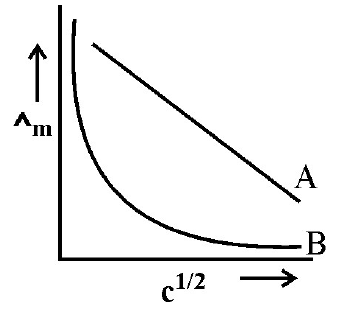
Answer the following : (i) Predict the nature of electrolytes A and B. (ii) What happens on extrapolation of to concentration approaching zero for electrolytes A and B ?
(a) The conductivity of 0.001 mol L acetic acid is S cm. Calculate the dissociation constant if for acetic acid is 390.5 S cm mol. (b) Write Nernst equation for the reaction at 25°C : (c) What are secondary batteries ? Give an example.
(a) Represent the cell in which the following reaction takes place : Calculate its emf if = 1.41 V. (b) How does molar conductivity vary with increase in concentration for strong electrolyte and weak electrolyte ? How can you obtain limiting molar conductivity () for weak electrolyte ?
(a) Write the cell reaction and calculate the e.m.f. of the following cell at 298 K : Sn (s) | (0.004 M) || (0.020 M) | (g) (1 bar) | Pt (s) (Given : V) (b) Give reasons : (i) On the basis of values, gas should be liberated at anode but it is gas which is liberated in the electrolysis of aqueous NaCl. (ii) Conductivity of decreases on dilution.
(a) For the reaction , = –43600 J at 25°C. Calculate the e.m.f. of the cell. [log = –n] (b) Define fuel cell and write its two advantages.
(a) Calculate for the following reaction at 298 K : Given : = 0.261 V (b) Using the values of A and B, predict which one is better for coating the surface of iron [ V] to prevent corrosion and why ? Given : V, V
(a) The conductivity of 0.001 mol L solution of is S cm. Calculate its molar conductivity and degree of dissociation (α). Given = 349.6 S cm mol and = 40.9 S cm mol. (b) Define electrochemical cell. What happens if external potential applied becomes greater than of electrochemical cell ?
Get every solution for all chapters
- Every board question of every chapter, each fully solved the way the board gives marks
- 19 complete board papers, each followed by its solutions
- Weightage and most-asked topics for every chapter
- Instant PDF download, colour and black & white print copies
Revising the chapter first? Complete Chemistry Notes for Class 12 (NCERT 2026-27, CBSE Board 2027) →
What you get in the pack
- Questions from 138 CBSE papers, 2016 to 2026: every set code available
- Complete: 2111 different questions and parts from all set codes, 10 chapters and 19 full papers
- Part A: all 10 chapters, questions sorted chapter-wise and by marks
- Year-wise weightage table and most-asked topics for every chapter
- Part B: 19 full board papers, each followed by its complete solutions
- Every reaction, mechanism and numerical worked with balanced equations
- Questions on topics out of the board syllabus flagged
All chapters in this pack
- PYQ Ch 1 Solutions
- PYQ Ch 2 Electrochemistry
- PYQ Ch 3 Chemical Kinetics
- PYQ Ch 4 The d- and f-Block Elements
- PYQ Ch 5 Coordination Compounds
- PYQ Ch 6 Haloalkanes and Haloarenes
- PYQ Ch 7 Alcohols, Phenols and Ethers
- PYQ Ch 8 Aldehydes, Ketones and Carboxylic Acids
- PYQ Ch 9 Amines
- PYQ Ch 10 Biomolecules
- Board Paper 2026 Set 56-1-1 with Solutions
- Board Paper 2026 Set 56-1-2 with Solutions
- Board Paper 2026 Set 56-1-3 with Solutions
- Board Paper 2026 Set 56-2-1 with Solutions
- Board Paper 2025 Set 56-1-1 with Solutions
- Board Paper 2025 Set 56-2-1 with Solutions
- Board Paper 2024 Set 56-1-1 with Solutions
- Board Paper 2024 Set 56-2-1 with Solutions
- Board Paper 2023 Set 56-1-1 with Solutions
- Board Paper 2023 Set 56-2-1 with Solutions
- Board Paper 2022 Term 2 Set 56-1-1 with Solutions
- Board Paper 2022 Term 2 Set 56-2-1 with Solutions
- Board Paper 2020 Set 56-1-1 with Solutions
- Board Paper 2020 Set 56-2-1 with Solutions
- Board Paper 2019 Set 56-1-1 with Solutions
- Board Paper 2019 Set 56-2-1 with Solutions
- Board Paper 2018 Set 56-1 with Solutions
- Board Paper 2017 Set 56-1 with Solutions
- Board Paper 2016 Set 56-1 with Solutions