
CBSE Class 12 Chemistry Question Paper 2026 (56/1/1) with Solutions
The complete CBSE Class 12 Chemistry board paper of 2026, Q.P. code 56/1/1: all 33 questions exactly as set, with marks. 19 solutions are free below. The Class 12 Chemistry PYQ Book: Solved Board Papers 2016-2026 (CBSE) solves all 19 papers in full and sorts every question chapter-wise.
Subject expert: Dr. S.L. Verma, B.Sc. (Hons), M.Sc. Chemistry, PhD · 23+ years teaching


Free: NCERT solutions for Class 12 Chemistry →
Question paper
Jump to: Question paperSolutions
2026 · Q.P. Code 56/1/1
Maximum marks: 70
Section A · Multiple choice and Assertion–Reason (1 mark each)
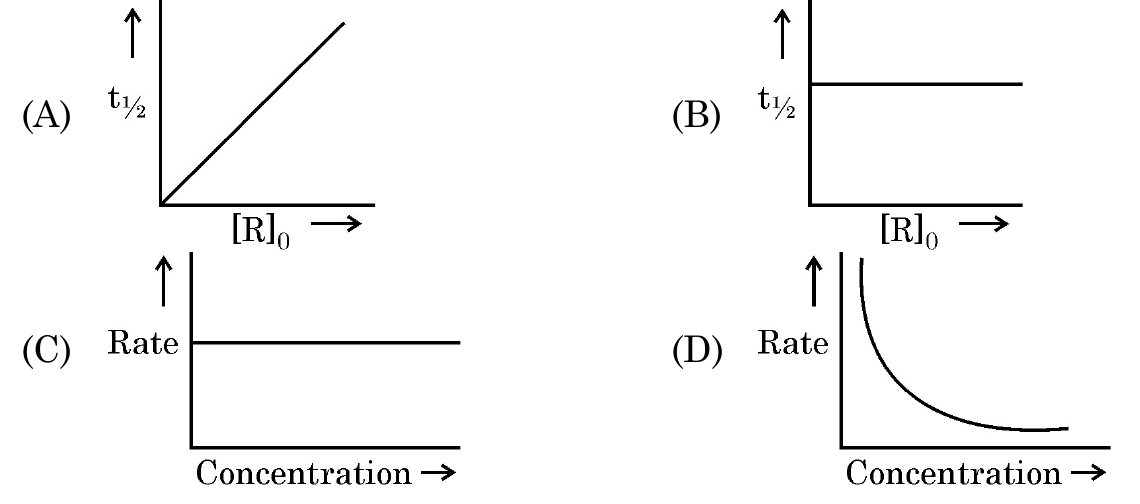
Which of the following curve represents the first order reaction?
Which of the following solutions will have the lowest freezing point in water?
Which of the following is not a transition metal?
Which of the following represents the fraction of molecules with energies equal to or greater than ?
What will happen during the electrolysis of aqueous solution of by using platinum electrodes?
Aspirin is obtained by acetylation of
The secondary valency of Co in the complex is
At low temperature, phenol reacts with dil. to yield
Which of the following is 'not' true about enantiomers?
Aniline on direct nitration yields
Which of the following amines has lowest value?
The deficiency of which of the following vitamins causes increased fragility of red blood cells and muscular weakness:
Assertion (A): It is not possible to separate the components of an azeotrope by fractional distillation.
Reason (R): Components of an azeotrope have the same composition in liquid and vapour phase and boil at a constant temperature.
Assertion (A): The presence of –OH group in phenols directs the incoming group to meta position in the ring.
Reason (R): –OH group in phenols activates the aromatic ring towards electrophilic substitution reaction.
Assertion (A): Actinoids show wide range of oxidation states.
Reason (R): Actinoids are radioactive in nature.
Assertion (A): The pentaacetate of glucose does not react with .
Reason (R): It indicates the presence of free –CHO group in glucose.
Section B · Very short answer (2 marks each)
What type of deviation from Raoult's law is shown by a mixture of phenol and aniline? Give reason. What will happen to the boiling point of the solution on mixing phenol and aniline?
Why are haloarenes less reactive towards nucleophilic substitution reaction? Give two reasons.
(a) Write IUPAC names of the following coordination compounds: (i) (ii)
(b) (i) Give a chemical test to show that and are ionisation isomers. (ii) What is meant by the 'Chelate effect'? Give an example.
Differentiate between the following: (i) Peptide linkage and Glycosidic linkage (ii) Essential amino acids and Non-essential amino acids
Following reaction takes place in one step: . How will the rate of above reaction change if the volume of the reaction vessel is decreased to one third of its original volume? Will there be any change in the order of reaction with the reduced volume?
Section C · Short answer (3 marks each)
For the first order thermal decomposition reaction, following data was obtained: . At t = 0 s, total pressure = 0.30 atm; at t = 30 s, total pressure = 0.50 atm. Calculate rate constant. [Given: log 3 = 0.48]
(a) (i) Why is the Equilibrium Constant () related to and not to ? (ii) Two metals 'A' and 'B' have standard electrode potential values of –0.24 V and +0.80 V respectively. Which of these will liberate hydrogen gas from dil. ? (iii) Write the cell reaction which occurs in lead storage battery when it is in charging.
(b) What type of battery is Mercury cell? Why it is more advantageous than dry cell? Write overall reaction taking place in Mercury cell.
Calculate the boiling point of a solution containing 0.61 g of benzoic acid (Molar mass = 122 g mol⁻¹) in 5 g of in which it dimerises to the extent of 88%. The boiling point and of are 46.2 °C and 2.3 K kg mol⁻¹ respectively.
Write the reactions of D-Glucose with the following: (a) HI (b) water (c) Conc.
Give reasons for the following: (a) Carboxylic acids have higher boiling point than alcohols of comparable molecular masses. (b) Alpha (α) hydrogens of aldehydes and ketones are acidic in nature. (c) Nucleophilic addition of ammonia and its derivatives does not occur with carbonyl group in strongly acidic medium.
Write the reaction involved in the following: (a) Reimer-Tiemann reaction (b) Kolbe's reaction (c) Friedal-Crafts acylation of anisole
Compound 'X' with molecular formula reacts with aqueous KOH to give an alcohol. The rate of this reaction depends only on the concentration of the compound 'X'. When an optically active isomer 'Y' of the compound 'X' was treated with aqueous KOH solution, the rate of reaction was found to be dependent on concentration of compound 'Y' and aqueous KOH both. (a) Write down the structural formula of both 'X' and 'Y'. (b) Out of 'X' and 'Y', which one will undergo racemisation and why? (c) Out of 'X' and 'Y', which one will form product with inversion of configuration and why?
Section D · Case-based (4 marks each)
The reaction of amines with mineral acids to form ammonium salts shows that these are basic in nature. Aliphatic amines are stronger bases than ammonia whereas aromatic amines are weaker bases than ammonia. Aliphatic and aromatic primary and secondary amines react with acid chlorides, anhydrides and esters by nucleophilic substitution reaction. The main problem encountered during electrophilic substitution reactions of aromatic amines is that of their high reactivity. Substitution tends to occur at ortho- and para-positions. Hinsberg reagent is used for the identification and distinction between primary, secondary and tertiary amines. Aryldiazonium salts, usually obtained from arylamines, undergo replacement of the diazonium group with a variety of nucleophiles to provide advantageous methods for producing aryl halides, cyanides, phenols and arenes.
(a) (i) Why is a stronger base than in aqueous solution? (ii) Write structural formulae of the compound A and B: (2)
(b) A compound 'X' with molecular formula reacts with Hinsberg reagent to give a product insoluble in alkali. Identify 'X'. (1)
OR
(b) How can you convert aniline to benzonitrile? (1)
(c) Why is – group of aniline acetylated before carrying out nitration? (1)
The Valence Bond Theory (VBT) explains the formation, magnetic behaviour and geometry of coordination compounds. The Crystal Field Theory (CFT) of coordination compounds is based on the effect of different crystal fields (provided by the ligands taken as point charges), on the degeneracy of d-orbital energies of the central metal atom/ion. The splitting of the d-orbitals provides different electronic arrangements in strong and weak crystal fields.
(a) In octahedral crystal field, energies of which d-orbitals will be raised when ligands approach the central metal atom/ion? Give reason in support of your answer. (2)
(b) Using crystal field theory, write the electronic configuration of central metal atom/ion of the following: (i) (ii) [At. No.: Co = 27] (1)
(c) is paramagnetic while is diamagnetic though both are tetrahedral. Why? [Atomic No.: Ni = 28] (1)
OR
(c) Write hybridization and magnetic behaviour of the complex . [Atomic No.: Fe = 26] (1)
Section E · Long answer (5 marks each)
(a) (i) An organic compound (X) has the molecular formula . Draw structures for (X) if it: (I) does not give Tollen's test but gives a positive iodoform test. (II) does not give Tollen's test and iodoform test but undergoes Aldol condensation. (III) undergoes Cannizzaro's reaction. (ii) Show how each of the following compounds can be converted to benzoic acid: (I) Acetophenone (II) Ethyl benzene
(b) (i) Draw structure of the 2, 4-dinitrophenyl hydrazone derivative of benzaldehyde. (ii) Arrange the following in increasing order of their reactivity towards HCN: Di-tert. butyl ketone, Acetaldehyde, Acetone (iii) Give a simple chemical test to distinguish between benzoic acid and ethyl benzoate. (iv) Write the name of the reagent to convert Ethanenitrile to Ethanal. (v) Draw the structure of 'X' in the following reaction: cyclohexanol 'X'
(a) (i) From the given data of values (V –1.18, Cr –0.91, Mn –1.18, Fe –0.44, Co –0.28, Ni –0.25, Cu +0.34), answer: (I) Why show irregular trend? (II) Why is value exceptionally positive? (III) Why value is highly negative? (ii) Write the ionic equations for the oxidising action of potassium permanganate for its reaction with in both acidic and alkaline solutions.
(b) (i) Name a member of the lanthanoid series (I) which exhibits +4 oxidation state (II) which exhibits +2 oxidation state. (ii) Why transition metals act as good catalyst? (iii) Why Cr has higher melting point than Mn? (iv) What happens when acidic solution of potassium permanganate is allowed to stand for sometime? Give the equation involved. What is this type of reaction called?
(a) Calculate emf and ΔG for the following cell at 298 K: . Given: V, V [1 F = 96500 C mol⁻¹, log 10 = 1]
(b) For the reaction: . Calculate emf of the cell at 25 °C. Given: ΔG° = –43500 J mol⁻¹ [log 10 = 1, 1 F = 96500 C mol⁻¹]
Solutions: CBSE 2026 · 56/1/1
Answer: (B)
For a first-order reaction , which does not depend on the initial concentration : a horizontal line. (Graph A is zero order, ; a horizontal rate–concentration line, C, is also zero order.)
Answer: (C) Hg
A transition element has an incompletely filled d subshell in the atom or in a common ion. Hg () has a full d subshell in the atom and in , so it is not regarded as a transition metal. (Ag and Cu have partly filled d orbitals in and .)
Answer: (D) gas will be released at anode
Cathode: (copper deposits). Anode: ; although oxidation of water has a lower , chloride is oxidised because of the overpotential for oxygen.
Answer: (D) 6
Secondary valency = coordination number = number of ligand donor atoms: 5 + 1 = 6.
Answer: (B)
Enantiomers rotate plane-polarised light by equal amounts but in opposite directions, so their specific rotations are equal in magnitude and opposite in sign. Their physical properties and reactivity (with achiral reagents) are identical.
Answer: (A)
Lowest means strongest base. The electron-releasing methyl groups increase the electron density on N; N,N-dimethylaniline is the strongest base here, while the electron-withdrawing – makes p-nitroaniline the weakest.
Answer: (A) Both A and R are true and R is the correct explanation of A.
Since the vapour has the same composition as the liquid, distillation cannot change the composition.
Answer: (B) Both A and R are true, but R is not the correct explanation of A.
The wide range of oxidation states arises because the 5f, 6d and 7s orbitals have comparable energies, not because of radioactivity.
Negative deviation. The hydrogen bonding between the phenolic –OH and the lone pair on the nitrogen of aniline (solute–solvent interaction) is stronger than the interactions in the pure components. So the vapour pressure is lower than expected by Raoult's law.
The boiling point of the solution increases (a maximum-boiling azeotrope can form).
(i) Diamminesilver(I) dicyanidoargentate(I)
(ii) Potassium trioxalatoferrate(III)
(i) A peptide linkage is the amide bond (–CO–NH–) formed between the –COOH of one amino acid and the – of another. A glycosidic linkage is the oxide (–O–) linkage joining two monosaccharide units.
(ii) Essential amino acids cannot be synthesised in the body and must be obtained through the diet (e.g. valine, leucine). Non-essential amino acids can be synthesised in the body (e.g. glycine, alanine).
Let x atm of decompose: , so atm.
Pressure of reactant at 30 s: atm.
It is a primary battery. Its cell potential stays constant (about 1.35 V) during its life because the overall reaction involves no ions in solution whose concentration changes; a dry cell's voltage falls with use.
Overall reaction:
(a) Prolonged heating with HI gives n-hexane:
(b) Bromine water oxidises –CHO to –COOH, giving gluconic acid:
(c) Conc. nitric acid oxidises both ends, giving saccharic acid:
(a) Phenol + + aq. NaOH, then → salicylaldehyde (2-hydroxybenzaldehyde):
(via the intermediate benzal chloride, after acidification)
(b) Sodium phenoxide + (4–7 atm, 400 K), then → salicylic acid (2-hydroxybenzoic acid):
(c) Anisole + / anhydrous → 2-methoxyacetophenone (minor) + 4-methoxyacetophenone (major):
(a) (i) In water, basicity depends on the inductive effect, solvation (H-bonding of the ammonium ion) and steric hindrance together. The methylammonium ion (, three N–H) is well stabilised by hydration, while the trimethylammonium ion has only one N–H and is poorly solvated; the bulky methyl groups also hinder solvation. So is more basic.
(ii) Hoffmann bromamide degradation: A = (methanamine). Benzoylation: B = (N-methylbenzamide).
(b) It forms a sulphonamide insoluble in alkali, so it is a secondary amine: N-methylethanamine, .
OR (b) Diazotise and then use the Sandmeyer reaction: .
(c) The – group is strongly activating, so direct nitration gives oxidation products and a mixture (including much meta product from the anilinium ion). Acetylation converts it to –, which is less activating, protects it from oxidation and gives mainly the para-nitro product; hydrolysis then regenerates the amine.
(i) (I) A methyl ketone: pentan-2-one, (or 3-methylbutan-2-one, ).
(II) A ketone without a group but with α-hydrogens: pentan-3-one, .
(III) An aldehyde with no α-hydrogen: 2,2-dimethylpropanal, .
(ii) (I) Haloform reaction: (or oxidation with alkaline ).
(II) Side-chain oxidation:
(i) (I) Because of irregular variation of the ionisation enthalpies () and the sublimation (atomisation) enthalpies across the series.
(II) Cu has a high enthalpy of atomisation and a high ionisation enthalpy, and the hydration enthalpy of is not enough to compensate.
(III) has a stable half-filled configuration, so Mn is readily oxidised to .
(ii) Acidic:
Alkaline/neutral:
Cell reaction: , n = 2.
V.
Get every solution for all 19 papers
- Every board question of every chapter, each fully solved the way the board gives marks
- 19 complete board papers, each followed by its solutions
- Weightage and most-asked topics for every chapter
- Instant PDF download, colour and black & white print copies
Revising the chapter first? Complete Chemistry Notes for Class 12 (NCERT 2026-27, CBSE Board 2027) →
What you get in the pack
- Questions from 138 CBSE papers, 2016 to 2026: every set code available
- Complete: 2111 different questions and parts from all set codes, 10 chapters and 19 full papers
- Part A: all 10 chapters, questions sorted chapter-wise and by marks
- Year-wise weightage table and most-asked topics for every chapter
- Part B: 19 full board papers, each followed by its complete solutions
- Every reaction, mechanism and numerical worked with balanced equations
- Questions on topics out of the board syllabus flagged
All chapters in this pack
- PYQ Ch 1 Solutions
- PYQ Ch 2 Electrochemistry
- PYQ Ch 3 Chemical Kinetics
- PYQ Ch 4 The d- and f-Block Elements
- PYQ Ch 5 Coordination Compounds
- PYQ Ch 6 Haloalkanes and Haloarenes
- PYQ Ch 7 Alcohols, Phenols and Ethers
- PYQ Ch 8 Aldehydes, Ketones and Carboxylic Acids
- PYQ Ch 9 Amines
- PYQ Ch 10 Biomolecules
- Board Paper 2026 Set 56-1-1 with Solutions
- Board Paper 2026 Set 56-1-2 with Solutions
- Board Paper 2026 Set 56-1-3 with Solutions
- Board Paper 2026 Set 56-2-1 with Solutions
- Board Paper 2025 Set 56-1-1 with Solutions
- Board Paper 2025 Set 56-2-1 with Solutions
- Board Paper 2024 Set 56-1-1 with Solutions
- Board Paper 2024 Set 56-2-1 with Solutions
- Board Paper 2023 Set 56-1-1 with Solutions
- Board Paper 2023 Set 56-2-1 with Solutions
- Board Paper 2022 Term 2 Set 56-1-1 with Solutions
- Board Paper 2022 Term 2 Set 56-2-1 with Solutions
- Board Paper 2020 Set 56-1-1 with Solutions
- Board Paper 2020 Set 56-2-1 with Solutions
- Board Paper 2019 Set 56-1-1 with Solutions
- Board Paper 2019 Set 56-2-1 with Solutions
- Board Paper 2018 Set 56-1 with Solutions
- Board Paper 2017 Set 56-1 with Solutions
- Board Paper 2016 Set 56-1 with Solutions