
Linear Programming: Class 12 PYQs 2022–2026 with solutions
All 19 CBSE board questions asked from Linear Programming in 6 board papers, with the year, set and marks of each. 11 are solved free below. The Class 12 Applied Mathematics PYQ Book: Solved Board Papers 2022-2026 (CBSE) has every solution, all chapters and 9 full board papers.
Subject experts: Ruchi Agarwal (B.Tech, M.Tech) and Vinay Wadhwani (B.Tech Electrical Engineering)



Linear Programming: board weightage
Board weightage 2022–2026
| Year | 2022 | 2023 | 2024 | 2025 | 2026 |
|---|---|---|---|---|---|
| Questions | 2 | 3 | 4 | 4 | 6 |
| Marks | 6 | 8 | 8 | 11 | 16 |
Most asked topics
19 questions from 6 papers. Repeated questions are shown once with every year they were asked.
Jump to: 1 mark2 marks3 marks4 marks
1 mark: MCQ and Assertion–Reason
The maximum value of the function , subject to the constraints , , , is:
Solution
In a LPP, the maximum value of subject to the constraints , , is
Solution
The graph of the inequation is the:
Solution
In an LPP, if the objective function has same maximum value on two corner points of the feasible region, then the number of points at which maximum value of Z occurs is:
Region represented by , lies in
2 marks: very short answer
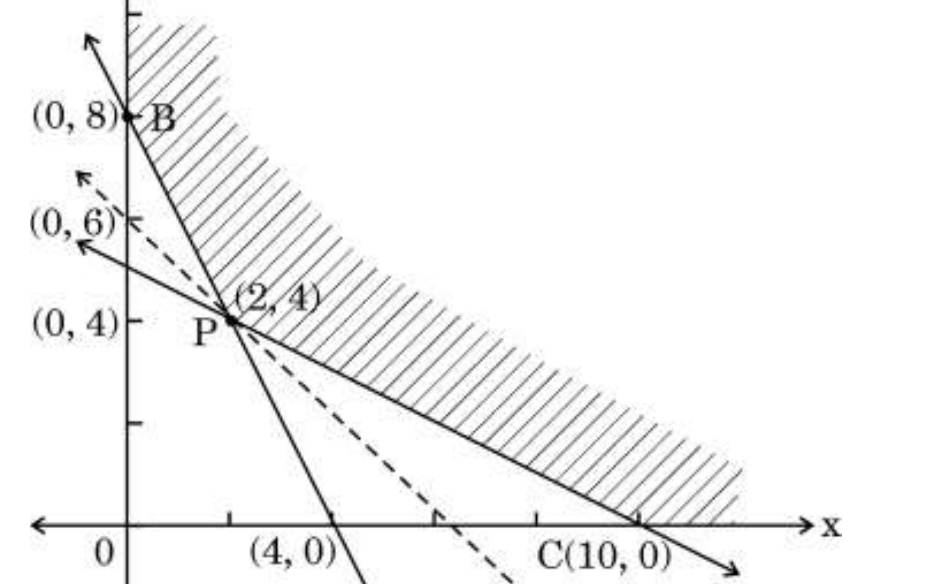
The feasible region for an LPP is shown shaded in the following figure. At which point does Min. occur? Also, find the minimum value of z.
Solution
, , .
The region is unbounded, so check the open half-plane : it has no point in common with the feasible region.
Minimum at P(2, 4).
Find the solution to the following linear programming problem (if it exists) graphically:
Maximize
subject to the constraints
.
Solution
(region below the line ).
A point cannot satisfy both and (the two parallel lines bound opposite sides). There is no feasible region, so the LPP has no solution.
Maximize , if possible, subject to the constraints: , ,
3 marks: short answer
Solve the following Linear Programming Problem (LPP) by graphical method: Minimize subject to constraints: , , , ,
Solution
Intersections: and : , . and : , .
Feasible region (below , above the other two lines) has corners , , , .
| Corner | |
|---|---|
| 300 | |
| 800 | |
| 260 | |
| 240 |
A manufacturer produces nuts and bolts for industrial machinery. It takes 1 hour of work on machine A and 3 hours on machine B to produce a packet of nuts, while it takes 3 hours on machine A and 1 hour on machine B to produce a packet of bolts. He earns a profit of ₹ 5 per packet of nuts and ₹ 2 per packet of bolts. How many packets of each should he produce per day so as to maximize his profit, if he operates his machines for at most 12 hours a day? Formulate this problem as an LPP and solve graphically.
Solution
Maximise subject to: machine A: ; machine B: ; .
Intersection: , ⇒ .
Corners: O(0,0): 0; (4,0): 20; (3,3): ; (0,4): 8.
Maximum profit ₹ 21 with 3 packets of nuts and 3 packets of bolts.
Solve the following Linnear Programming Problem (LPP) graphically:
Maximize
subject to the constraints:
,
Solution
: 0, 4500, 5500, 5400, 3000.
Maximum at , .
There are two types of fertilizers and . consists of 10% nitrogen and 6% phosphoric acid. consists of 5% nitrogen and 10% phosphoric acid. After testing the soil conditions, a farmer finds that he needs atleast 14 kg of nitrogen and 14 kg of phosphoric acid for his crop. If costs ₹ 6 per kg and costs ₹ 5 per kg, how much of each type of fertilizer should be used so that the cost is minimum. Formulate a linear programming problem.
Solve the following linear programming problem graphically:
Maximise
subject to
.
Maximise subject to constraints: , , , .
4 marks: case-based / source-based
A man has ₹ 15,000 for purchasing rice and wheat. A bag of rice and a bag of wheat cost ₹ 1,800 and ₹ 1,200 respectively. He has a storage capacity of 10 bags. He earns a profit of ₹ 100 and ₹ 90 per bag of rice and wheat respectively. Assuming that he can sell all the items that he can buy, he purchases bags of rice and bags of wheat.
Based on the above information and by formulation of Linear Programming Problem (LPP), answer the following questions:
(i) Write the objective function which represents the total profit from the sale of total bags of both types. [1]
(ii) Write the constraints that relate the total cost of both types of bags. [1]
(iii)(a) How many bags of each type should the man buy to get maximum profit? [2]
OR
(iii)(b) Find the profit that the man can earn by selling all the bags. [2]
Solution
(ii) Cost: , i.e. . (The other constraints are storage and , .)
(iii)(a) Corner points of the feasible region: ; on ; the intersection of and : subtracting gives , ; and .
| Corner | |
|---|---|
| 0 | |
| 833.33 | |
| 950 (maximum) | |
| 900 |
(iii)(b) Maximum profit ₹ 950.
There are two factories located one at P and the other at Q. From these locations, a certain commodity is to be delivered to each of the three depots situated at A, B and C. The weekly requirements of the depots are respectively 4, 4 and 6 units of the commodity while the production capacity of the factories at P and Q are 9 and 5 units respectively. The cost of transportation per unit is given as:
| From / To | A | B | C |
|---|---|---|---|
| P | 160 | 100 | 150 |
| Q | 100 | 120 | 100 |
(Cost in ₹.) Based on the above information, answer the following questions:
Let units and units of the commodity be transported from factory P to the depots at A and B respectively, then
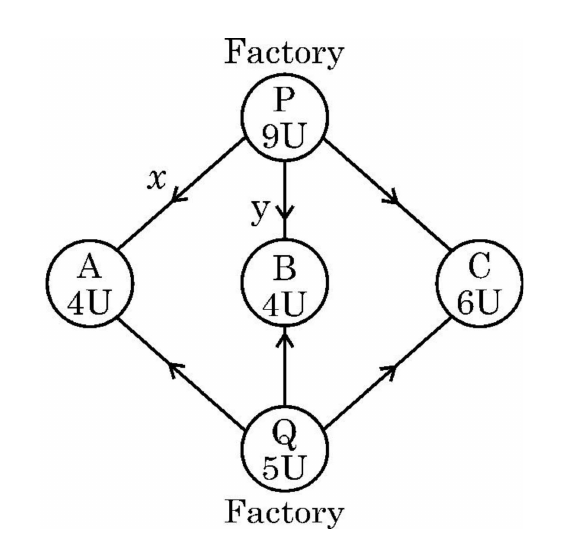
(i) Find (in terms of and ) how many units of commodity be transported from factory P to depot C. [1]
(ii) Find how many units of commodity be transported from factory Q to A, B and C respectively. [1]
(iii) Using (i) and (ii), find the total transportation cost . [2]
OR
(iii) Using (i) and (ii), find the constraint inequalities for minimum cost . [2]
Solution
(i) P sends to A and to B, so P → C units.
(ii) Q → A ; Q → B ; Q → C units.
(iii)
.
OR (iii) Every quantity transported must be non-negative:
, ; ; ; ; .
So: minimise subject to , , , , .
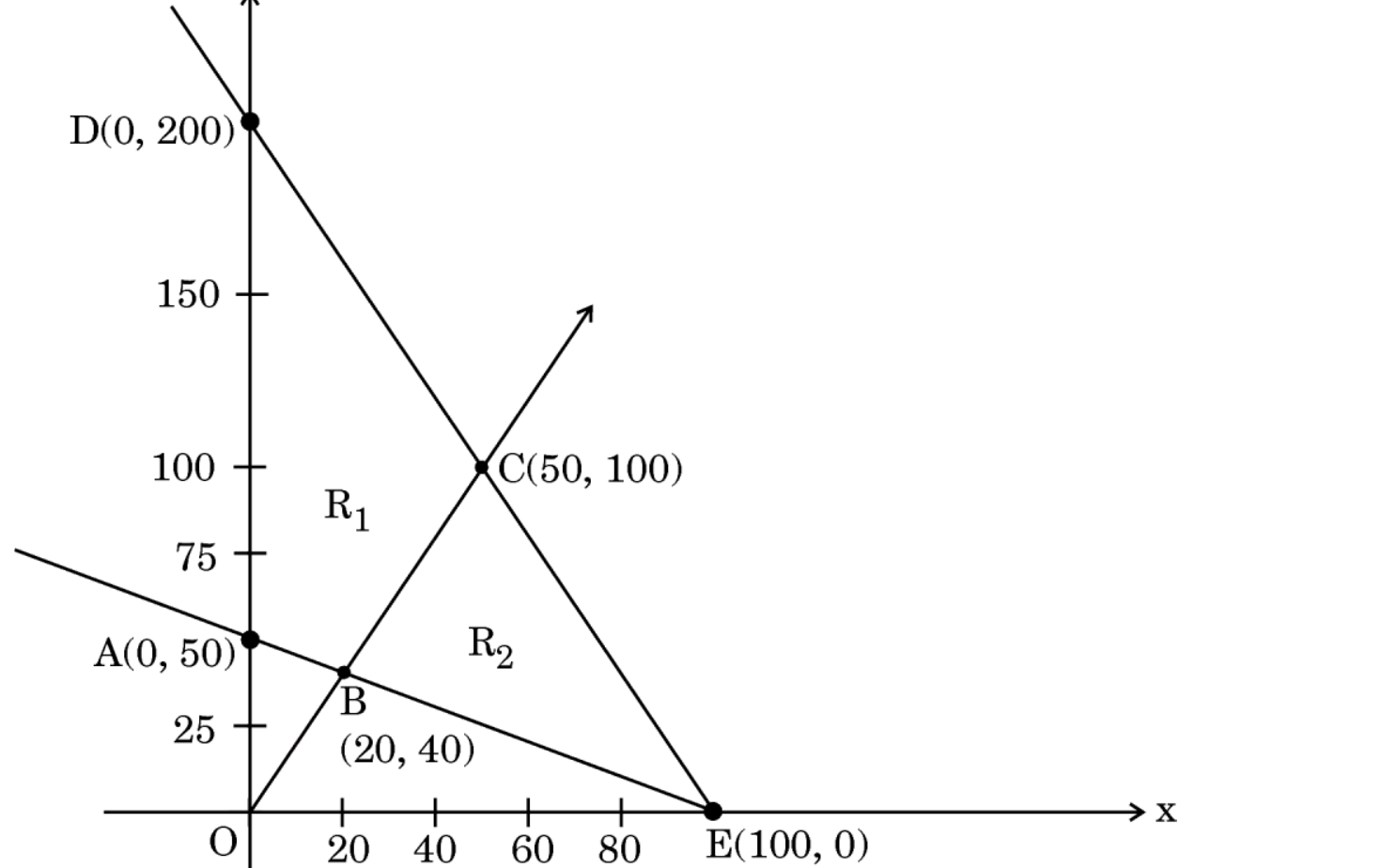
In number theory, it is often important to find factors of an integer N. The number N has two trivial factors, namely 1 and N. Any other factor, if exists, is called non-trivial factor of N. Naresh has plotted a graph of some constraints (linear inequations) with points A(0, 50), B(20, 40), C(50, 100), D(0, 200) and E(100, 0). This graph is constructed using three non-trivial constraints and two trivial constraints. One of the non-trivial constraints is .
Based on the above information, answer the following questions:
(i) What are the two trivial constraints? [1]
(ii)(a) If is the feasible region, then what are the other two non-trivial constraints? [2]
OR
(ii)(b) If is the feasible region, then what are the other two non-trivial constraints? [2]
(iii) If is the feasible region, then find the maximum value of the objective function . [1]
Solution
(ii) The line through O, B(20, 40) and C(50, 100) has slope 2: . The line through D(0, 200) and E(100, 0): . Line AE is .
(ii)(a) lies to the left of (above) the line and below the line DE: the constraints are (i.e. ) and .
OR (ii)(b) lies to the right of (below) the line and below DE: the constraints are (i.e. ) and .
(iii) Corner points of and : A(0, 50): 100; B(20, 40): 180; C(50, 100): ; D(0, 200): 400. Maximum at C(50, 100).
A factory manufactures tennis rackets and cricket bats. A tennis racket takes hours of machine time and 3 hours of craftsmanship in its making; while a cricket bat takes 3 hours of machine time and 1 hour of craftsmanship. In a day, the factory has availability of not more than 42 hours of machine time and 24 hours of craftsmanship. Profit on a racket and on a bat are ₹ 20 and ₹ 10 respectively.
Based on the above information, answer the following questions:
(i) If and are the numbers of bats and rackets manufactured by the factory, then write the expression of total profit. [1]
(ii) Write the constraint that relates the number of craftsmanship hours. [1]
(iii)(a) Determine the maximum profit (in ₹) earned by the factory. [2]
OR
(iii)(b) How many bats and rackets respectively, are to be manufactured to earn maximum profit? [2]
A dietician wishes to mix two types of foods and in such a way that the vitamin content of the mixture contains at least 8 units of vitamin A and 10 units of vitamin C. Food contains 2 units/kg of vitamin A and 1 unit/kg of vitamin C, while Food contains 1 unit/kg of vitamin A and 2 units/kg of vitamin C. It costs ₹ 5 per kg to purchase Food and ₹ 7 per kg to purchase Food .
Based on the above information, answer the following questions:
(a) To find out the minimum cost of such a mixture, formulate the above problem as a LPP.
(b) Determine the minimum cost of the mixture.
Get every solution for all chapters
- Every board question of every chapter, each fully solved the way the board gives marks
- 9 complete board papers, each followed by its solutions
- Weightage and most-asked topics for every chapter
- Instant PDF download, colour and black & white print copies
Revising the chapter first? Complete Applied Maths Notes for Class 12 (CBSE 241, 2026-27, Board 2027) →
What you get in the pack
- Every CBSE Class 12 Applied Mathematics board paper, 2022 to 2026 (9 papers, main and compartment, all in full)
- All 14 chapters and 9 board papers complete
- Part A: all 14 chapters, questions sorted chapter-wise and by marks
- Year-wise weightage table and most-asked topics for every chapter
- Part B: each full board paper followed by its complete solutions
- EMI, CAGR, t-tests, trend lines and LPPs worked step by step
- Solutions checked against the official CBSE marking schemes
All chapters in this pack
- PYQ Ch 1 Numbers, Quantification and Numerical Applications
- PYQ Ch 2 Numerical Inequalities
- PYQ Ch 3 Matrices
- PYQ Ch 4 Determinants
- PYQ Ch 5 Differentiation
- PYQ Ch 6 Applications of Derivatives
- PYQ Ch 7 Integration and its Applications
- PYQ Ch 8 Differential Equations and Modelling
- PYQ Ch 9 Probability Distributions
- PYQ Ch 10 Inferential Statistics
- PYQ Ch 11 Index Numbers and Time-based Data
- PYQ Ch 12 Perpetuity, Sinking Funds and EMI
- PYQ Ch 13 Returns, Growth and Depreciation
- PYQ Ch 14 Linear Programming
- Board Paper 2026 Set 465 with Solutions
- Board Paper 2026 Supplementary Set 465/7 with Solutions
- Board Paper 2025 Set 465 with Solutions
- Board Paper 2025 Supplementary Set 465/S with Solutions
- Board Paper 2024 Set 465 with Solutions
- Board Paper 2024 Supplementary Set 465/S with Solutions
- Board Paper 2023 Set 465 with Solutions
- Board Paper 2022 Term 2 Set 465 with Solutions
- Board Paper 2022 Term 2 Supplementary Set 465 with Solutions